Today at a Glance
| Phase | Time | Activity |
|---|---|---|
| 🌍 Contextualize | 10 min | Binary data in the city — metro card, baggage tag, BCN airport |
| ⚠️ Reframe | 15 min | wire ≠ variable · reg ≠ register · operators as gates |
| 🛠 Assemble | 70 min | 2:1 mux → 4:1 mux → ripple-carry adder → 7-seg decoder |
| 🛡 Fortify | 45 min | Sim every block · width-mismatch hunt · structural variant |
| 🔗 Transfer | 10 min | Debrief · Tue catch-up · preview Day 3 + Sagrada Família |
▸ Phase 1 of 5 · ~10 min
🌍 Contextualize
Binary data is in everything around you in Barcelona
The City Runs on Vectors
- T-Casual metro card — RFID payload is a few bytes of binary
- BCN airport baggage tag — 10 decimal digits, encoded as a barcode of bits
- Camp Nou turnstile — gate logic on a binary "valid ticket?" signal
- Sagrada Família 3D printer — every layer is a packed bit-pattern
Today's job
Learn how HDL represents binary data — single bits, bus-width vectors, slices, concatenations — and the operators that move them around.
Every system you've seen since landing in Barcelona uses these primitives. Today you learn the syntax.
▸ Phase 2 of 5 · ~15 min
⚠️ Reframe
Sharper lens on the pre-class videos (V1 + V2, watched before arrival)
⚠️ wire ≠ Variable. reg ≠ Register.
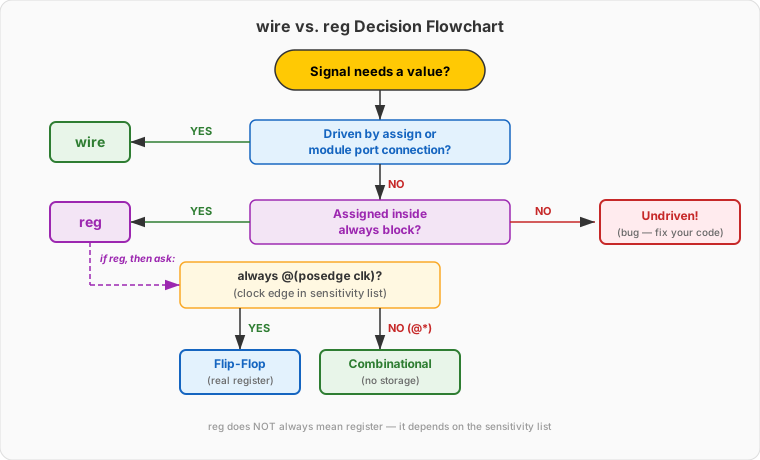
❌ Wrong Model
"Variables are storage boxes I put values into. wire stores a value; reg is a register."
✓ Right Model
wire is a physical connection — no storage. reg means "the simulator needs to remember this between events" — it might be a register, or it might be combinational. SystemVerilog fixes this with logic.
The Mux is Everywhere
assign y = sel ? a : b;       // 2:1 mux — one wire from two
assign y = s[1] ? (s[0] ? d : c)
                : (s[0] ? b : a);   // 4:1 mux nested

assign d = a + b;             // adder (synth produces real gates)
assign m = {nibble, 4'b0};    // concat — pad with zeros
assign r = {4{1'b1}}; // replication — 4'b1111if/else, every case, every conditional in HDL eventually becomes muxes. Internalise that mental picture now — it pays off on Day 3.
▸ Phase 3 of 5 · ~70 min · You build
🛠 Assemble
Four blocks. Each one ends with bits on the board.
Build Plan
- Ex 1 · 20 min 2:1 then 4:1 mux — use the
? :operator. Buttons for select & data, LED for output. - Ex 2 · 25 min 4-bit ripple-carry adder — write one
full_addermodule, instantiate four times. First taste of hierarchy. - Ex 3 · 25 min Hex → 7-segment decoder — 16-entry case statement, lights both displays on the Go Board.
2:1 Mux — Starter
module mux_2to1 (
    input  wire a, b,
    input  wire sel,
    output wire y
);
    assign y = sel ? a : b;
endmodule
Map to the Go Board:
sel← Button 0 ·a← Button 1 ·b← Button 2y→ LED 0
Widen to 4-bit inputs ([3:0]) once the 1-bit version is solid.
Ripple Adder — Hierarchy in Practice
module full_adder (
    input  wire a, b, cin,
    output wire sum, cout
);
    assign sum  = a ^ b ^ cin;
    assign cout = (a & b) | (cin & (a ^ b));
endmodule

module adder4 (
    input  wire [3:0] a, b,
    input  wire       cin,
    output wire [3:0] sum,
    output wire       cout
);
    wire [3:0] c;
    full_adder fa0 (.a(a[0]), .b(b[0]), .cin(cin),  .sum(sum[0]), .cout(c[0]));
    full_adder fa1 (.a(a[1]), .b(b[1]), .cin(c[0]), .sum(sum[1]), .cout(c[1]));
    full_adder fa2 (.a(a[2]), .b(b[2]), .cin(c[1]), .sum(sum[2]), .cout(c[2]));
    full_adder fa3 (.a(a[3]), .b(b[3]), .cin(c[2]), .sum(sum[3]), .cout(cout));
endmodule
Four instances of the same module. This is what HDL hierarchy looks like.
Hex → 7-Segment Pattern
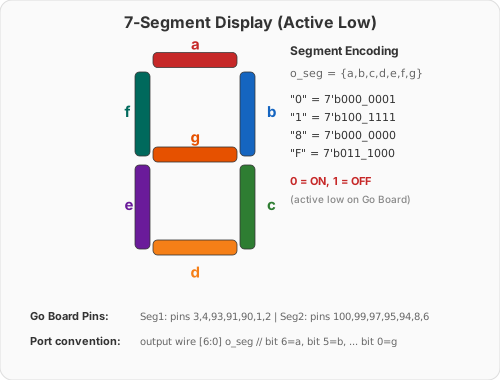
module hex_to_7seg (
    input  wire [3:0] hex,
    output reg  [6:0] seg   // {a,b,c,d,e,f,g}
);
    always @(*) begin
        case (hex)
            4'h0: seg = 7'b1111110;
            4'h1: seg = 7'b0110000;
            4'h2: seg = 7'b1101101;
            // ... fill in 3 through F
            default: seg = 7'b0000000;
        endcase
    end
endmoduledefault clause — always — to avoid latch inference (we'll dive into that tomorrow).
▸ Phase 4 of 5 · ~45 min · Verify · test · harden
🛡 Fortify
Make every block earn its place
Sim Before Solder — Three TBs Today
# Provided testbenches — run each one
cd labs/week1_day02/ex2_mux_hierarchy/starter && make sim
cd labs/week1_day02/ex3_adder/starter         && make sim
cd labs/week1_day02/ex4_seven_seg/starter     && make sim
What the TBs do
- Mux: every
sel× inputs combination - Adder: known-answer + carry edge cases
- 7-seg: all 16 hex digits checked against golden pattern
Discipline reminder
Don't program the board until all three TBs print "0 failed." Yesterday's Day-1 workflow, applied four times today.
The Width-Mismatch Hunt
wire [3:0] sum;
wire [3:0] a, b;
assign sum = a + b + 1'b1;   // ⚠ Yosys may warn — width inference
                              //   The literal 1'b1 is 1-bit; adder
// result is 5-bit (with carry).- Run synthesis and read the log. Yosys prints width warnings — don't bury them.
- Common fixes: use
4'd1for sized literals, declaresumas[4:0], or$signedwhen intent is signed. - Why this matters: on Day 10 we measure timing; on Day 14 we hunt PPA wins. A 5-bit adder costs more LUTs than a 4-bit one. Width is hardware.
Hardware Verification
- 2:1 mux: hold
sellow → LED reflectsb; flipsel→ LED reflectsa. - 4:1 mux: all four (
s[1], s[0]) combinations route the correct input. - Adder: use two pairs of buttons as 2-bit inputs (with the upper bits tied off in
.pcf); read sum on LEDs. - 7-seg: cycle
0000 → 1111on the input switches — both displays must light correctly. Phone-camera a 0–F sweep.
▸ Phase 5 of 5 · ~10 min
🔗 Transfer
What carries forward
What Generalizes
① Vectors are universal. Every bus on every chip — AXI, UART, AHB — is a Verilog vector.
② Muxes are the substrate of choice. Every conditional becomes one.
③ Hierarchy is how big designs stay sane. Today: a 4-bit adder from 4 full-adders. Week 4: a UART from 4 sub-blocks.
④ Read the synthesis log. Warnings = future bugs.
Tuesday Catch-up, then → Combinational Logic
Tue 5/26 is a catch-up block: finish board bring-up and the combined Day 1+2 lab. No new material — instructor-supported time to get everyone level.
Wed 5/27 (Day 3) brings always @(*), if/else, case — and the #1 beginner synthesis bug: latch inference. You'll build a 4-bit ALU and use yosys show to see if/else vs case.
Wed PM: Sagrada Família
Gaudí's structural models were essentially combinational: load in → shape out, no memory of sequence. Notice the branching geometry — it's a physical if/else tree. We open Day 3 with your photos.
🔗 End of Day 1+2 · Disfruta Barcelona
Three blocks, one workflow.
You now have the vocabulary to describe any combinational circuit.
Day 3 puts it inside always blocks — and shows you what can go wrong.