Today at a Glance
| Phase | Time | Activity |
|---|---|---|
| 🌍 Contextualize | 10 min | Real-time decisions in Barcelona infrastructure |
| ⚠️ Reframe | 15 min | if/else vs case = different hardware |
| 🛠 Assemble | 70 min | Latch hunt · priority encoder · 4-bit ALU |
| 🛡 Fortify | 45 min | Sim · yosys show diff · first PPA compare |
| 🔗 Transfer | 10 min | Brief for the Sagrada visit · Day 4 preview |
▸ Phase 1 of 5 · ~10 min
🌍 Contextualize
Decisions that have to happen the instant the inputs change
Combinational = Instant Response
- Traffic light at Plaça Catalunya — a phase controller turns sensor inputs into a green/amber/red output the moment a car arrives
- Sagrada Família structural model — load in → shape out, no memory of when the load arrived
- Camp Nou turnstile — valid ticket bits → gate open signal, instant
This afternoon
Sagrada Família visit. Gaudí's designs are essentially massive combinational systems: every load distributes simultaneously through a branching structure. Take photos — we'll use them tomorrow.
All of today's hardware describes "input changes ⇒ output changes now." No clocks. No memory. Pure logic.
▸ Phase 2 of 5 · ~15 min
⚠️ Reframe
Same intent, different gates
⚠️ if/else ≠ case in Hardware
❌ Wrong Model
"They're equivalent — pick the prettier one."
✓ Right Model
if/else → priority mux chain. Later branches sit on a longer combinational path.case → parallel mux. All branches evaluated at once, tool picks by index.
case when branches are mutually exclusive (ALU opcodes, FSM states).Use
if/else when priority is part of the spec (arbiters, interrupt handlers).
Latch vs. Combinational — the Picture
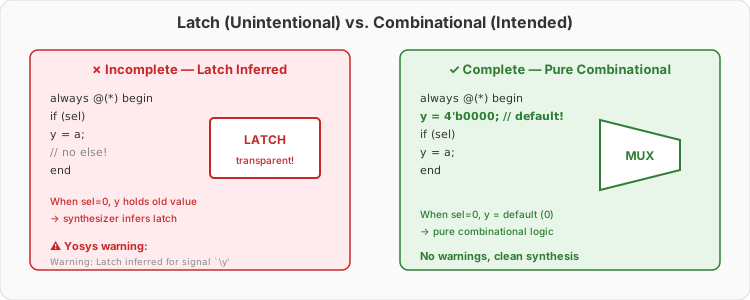
always @(*) and the signal must remember its old value → Yosys infers a latch. Cover every path → pure combinational logic. This is the bug you'll hunt in Ex 1.
The Latch Trap
// ❌ Buggy — no else, no default
always @(*) begin
    if (sel == 2'b00) y = a;
    if (sel == 2'b01) y = b;
    // when sel == 2'b10 or 2'b11, y holds its previous value
    // → Yosys infers a LATCH
end
// ✓ Fixed — default at the top
always @(*) begin
y = 1'b0; // default covers every path
case (sel)
2'b00: y = a;
2'b01: y = b;
2'b10: y = c;
2'b11: y = d;
endcase
endfound and reported 1 problem with "latch" in it = you have a bug. Always.
▸ Phase 3 of 5 · ~70 min · You build
🛠 Assemble
Three builds, escalating complexity
Build Plan
- Ex 1 · 15 min Latch detection — synth buggy code, find the latch warning, fix it, re-synth.
- Ex 2+3 · 25 min Priority encoder — first with
if/else, then withcasez. Same I/O, different gates. - Ex 5 · 25 min 4-bit ALU —
caseon opcode: ADD, SUB, AND, OR, XOR. Wire to switches + LEDs.
case, but an interrupt-style "abort" using if override. See how both compose.
Priority Encoder — Two Styles
if/else style
always @(*) begin
    out = 3'd0;
    if      (in[3]) out = 3'd4;
    else if (in[2]) out = 3'd3;
    else if (in[1]) out = 3'd2;
    else if (in[0]) out = 3'd1;
end
casez style
always @(*) begin
    out = 3'd0;
    casez (in)
        4'b1???: out = 3'd4;
        4'b01??: out = 3'd3;
        4'b001?: out = 3'd2;
        4'b0001: out = 3'd1;
    endcase
endcasez makes it explicit with ? don't-cares; if/else hides it in branch order.
4-Bit ALU — Canonical case
module alu4 (
    input  wire [3:0] a, b,
    input  wire [2:0] op,
    output reg  [3:0] y
);
    localparam OP_ADD = 3'd0, OP_SUB = 3'd1,
               OP_AND = 3'd2, OP_OR  = 3'd3, OP_XOR = 3'd4;

    always @(*) begin
        y = 4'd0;                       // default — kills latches
        case (op)
            OP_ADD: y = a + b;
            OP_SUB: y = a - b;
            OP_AND: y = a & b;
            OP_OR:  y = a | b;
            OP_XOR: y = a ^ b;
            default: y = 4'd0;          // belt and suspenders
        endcase
    end
endmodule
Use upper switches for op, lower switches for a/b, LEDs for y.
▸ Phase 4 of 5 · ~45 min · Verify · test · harden · PPA
🛡 Fortify
Latch-free, sim-clean, gate-counted
Simulation as Latch Detective
cd labs/week1_day03/ex1_latch_bugs/starter
make sim    # TB outputs FAIL with an X if a latch is present
✓ Two independent checks
- Sim TB catches X values → tells you which input drives a latch
- Yosys log catches inference → tells you which signal latched
- When both agree, the bug is real
❌ Easy to miss
A latch can produce correct outputs if the inputs happen to drive it the right way. Sim + synth catches the latent case before silicon does.
First PPA Compare — yosys stat
# Synthesize the SAME priority encoder three ways
yosys -p "synth_ice40 -top pe_if;   stat" pe_if.v
yosys -p "synth_ice40 -top pe_case; stat" pe_case.v
yosys -p "synth_ice40 -top pe_casez; stat" pe_casez.v
Compare the SB_LUT4 count for each variant. Predict which is cheapest before reading the numbers.
This is the start of the PPA thread — it runs all the way to Day 14.
Visualize the Difference — yosys show
yosys -p "read_verilog pe_if.v; \
          proc; opt; flatten; \
          show -prefix pe_if -format svg"
Open pe_if.svg and pe_case.svg side by side on the projector. The if/else version is a visibly longer chain; the case version is a fan-in mux.
Hardware Verification — ALU
- Each opcode visible on LEDs? Sweep
opthrough 0..4 with fixeda, b. - SUB carry behavior makes sense?
3 - 5wraps to0xEin 4-bit unsigned. - Bitwise ops give expected pattern? Set
a = 4'b1100,b = 4'b1010, check AND/OR/XOR. - Undefined opcode = default value? Set
op = 3'd7— should be all-zeros, never X.
▸ Phase 5 of 5 · ~10 min
🔗 Transfer
Carry it to Sagrada this afternoon
At Sagrada Família This Afternoon
- Look up at the columns. Each one is a multi-way branch — Gaudí's physical
casestatement, splitting load into sub-loads. - Look for the catenary models. They're upside-down hanging chains — load goes in, shape comes out, no memory of when. That's combinational.
- Look at the stained glass. Light in → colored light out. The window has no clock.
- Bring a photo. One picture per student — we open Day 4 with them on the projector.
Thursday: Montserrat · Friday → Clocked Logic
Thu 5/28 is the Montserrat excursion — no class. Day 4 is Friday 5/29.
Day 4 introduces time: always @(posedge clk), flip-flops, counters, a real blinker from the 25 MHz crystal. This is where you start using <= instead of = — the rule is simple; the reasoning is deep.
Before Friday
- 📺 Watch the Day 4 video (~50 min) — Thu evening, after Montserrat
- 📝 Day 4 pre-class quiz
- 🎨 Bring a Sagrada photo — we open Day 4 with them
🔗 End of Day 3 · Sagrada Família 17:00
No clocks. Just decisions.
You can now build any combinational circuit, detect a latch, and read a Yosys schematic.
After Montserrat, Friday we add a clock — and everything changes.