Today at a Glance
| Phase | Time | Activity |
|---|---|---|
| 🌍 Contextualize | 10 min | Counting in the city · Semidynamics framing |
| ⚠️ Reframe | 15 min | delay() ≠ a counter · sim ≠ proof · TBs find bugs |
| 🛠 Assemble | 70 min | Debouncer · LED chase · self-checking TB · AI-generated TB |
| 🛡 Fortify | 45 min | Noisy-input stim · AI TB review · hardware verify |
| 🔗 Transfer | 10 min | Brief for Semidynamics · D7 preview |
▸ Phase 1 of 5 · ~10 min
🌍 Contextualize
Every digital system counts, shifts, and debounces
The City Counts
- Metro L3 train doors — debounced sensors decide when to close
- Camp Nou turnstile counters — each click is a saturating counter event
- BCN airport gate timers — countdowns + state-aware displays
- Semidynamics RISC-V pipelines — built from the same counters and shift registers you'll write today
This afternoon · 16:00
Semidynamics — RISC-V vector processor startup in Barcelona. Ask: how much of their development effort is verification? The answer will reframe today's Fortify phase.
Counters · shift registers · debouncers · testbenches. Four primitives that show up in every commercial design.
▸ Phase 2 of 5 · ~15 min
⚠️ Reframe
Two software habits to unlearn today
⚠️ delay() Is Not Hardware
❌ Wrong Model
"To wait 10 ms for a button to stop bouncing, call delay(10). It works in Arduino — same idea here."
✓ Right Model
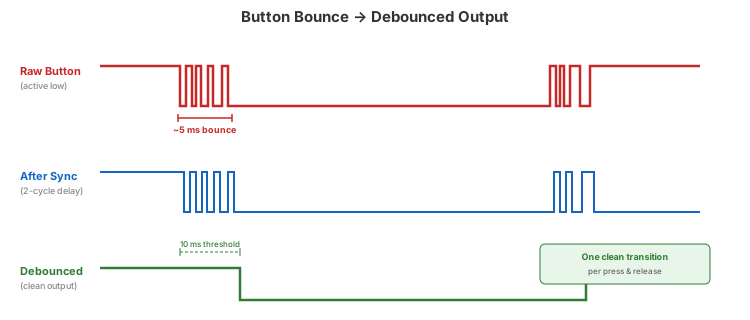
Hardware doesn't wait — it counts clock cycles. A debouncer is a saturating counter: increment when the input is stable, reset when it changes, output flips only when the counter saturates.
10 ms @ 25 MHz = 250 000 cycles — parameterize the threshold.
Why a Button Needs Debouncing
⚠️ Simulation Does Not Prove Correctness
❌ Wrong Model
"My testbench printed PASS, so my module works."
✓ Right Model
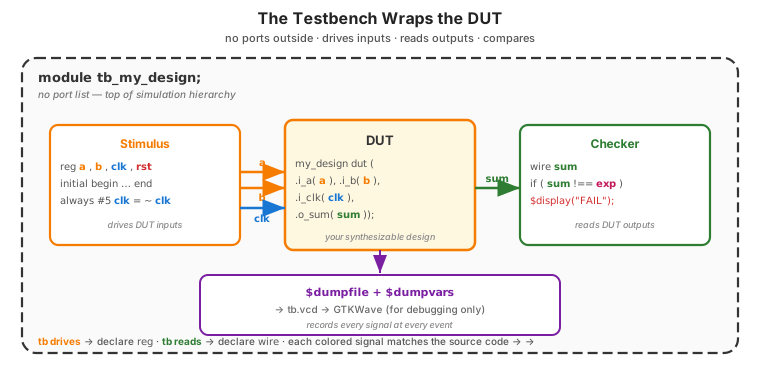
Simulation only proves correctness for the cases you tested. A TB finds bugs; it cannot prove their absence. The discipline: directed tests for known corners, then sweeps for everything else.
A Testbench Wraps the DUT
The Self-Checking Pattern
// Apply inputs → wait → compare → report
a = 4'd3; b = 4'd5; op = OP_ADD; #10;
if (y !== 4'd8) begin
    $display("FAIL: ADD 3+5 got %0d", y);
    fails = fails + 1;
end

// At the end:
if (fails == 0) $display("PASS: %0d tests", tests);
else            $display("FAIL: %0d/%0d", fails, tests);
$finish;!==, not!=— catchesX/Z- Count both fails and tests — silent zero-test runs are a footgun
$finish, not infinite loops — otherwise the simulator never returns
▸ Phase 3 of 5 · ~70 min · You build · you test
🛠 Assemble
Build the DUTs · then build the TBs that prove them
Build Plan — Two Halves
- Ex 1 · 20 min Reusable debouncer — parameterized threshold, 2-FF synchronizer baked in. Sim with a noisy stimulus.
- Ex 2 · 15 min 8-bit shift register (PISO) — the building block for UART (Week 3).
- Ex 3 · 10 min LED chase pattern — counter (speed) + shift register (pattern). Visible Knight Rider sweep on the Go Board.
- Ex 4 · 15 min Hand-written ALU TB — self-checking, every opcode, edge cases.
- Ex 5 · 🤖 10 min AI-generated debouncer TB — prompt → critique → fix → run.
$readmemh stimulus vectors) — preview of Day 9.
Debouncer — The Universal Snippet
module debouncer #(
    parameter THRESHOLD = 250_000      // 10 ms @ 25 MHz
)(
    input  wire clk, rst,
    input  wire in_async,
    output reg  out_clean
);
    // 2-FF synchronizer
    reg s1, s2;
    always @(posedge clk) {s2, s1} <= {s1, in_async};

    reg [$clog2(THRESHOLD)-1:0] cnt;
    always @(posedge clk) begin
        if (rst)                cnt <= 0;
        else if (s2 != out_clean) begin
            if (cnt == THRESHOLD-1) begin
                out_clean <= s2;        // commit
                cnt       <= 0;
            end else cnt <= cnt + 1;
        end else cnt <= 0;              // reset on noise
    end
endmodule
Keep this snippet in your personal library. You'll use it in every project this course.
LED Chase — Counter × Shift Register
module led_chase (
    input  wire       clk,
    input  wire       dir,        // 1 = left, 0 = right
    output reg  [3:0] led
);
    reg [22:0] tick_cnt;
    wire tick = (tick_cnt == 23'd2_500_000 - 1);  // ~10 Hz

    always @(posedge clk) tick_cnt <= tick ? 0 : tick_cnt + 1;

    initial led = 4'b0001;
    always @(posedge clk) if (tick) begin
        led <= dir ? {led[2:0], led[3]}      // rotate left
                   : {led[0],   led[3:1]};   // rotate right
    end
endmodule
First design that combines two sequential blocks. This is RTL composition.
🤖 AI-Generated Debouncer TB
Prompt scaffolding (use this as a template — paste DUT interface verbatim):
Generate a self-checking Verilog testbench for this debouncer.
Interface: clk, rst, in_async, out_clean. Parameter THRESHOLD (use 8 for sim).
Test cases:
  1. Reset behavior
  2. Stable input -> out_clean follows after THRESHOLD cycles
  3. Bouncing input (toggle 5x, then steady) -> out_clean only flips once
  4. Glitch shorter than THRESHOLD -> out_clean does NOT change
Use $display PASS/FAIL with !== comparisons, $finish at end.
Target Icarus Verilog (IEEE 1364-2005). No SystemVerilog features.
- Run it. Does it compile under
iverilog? - Does it test the bounce case correctly? Many AIs forget to reset the counter mid-bounce.
- Save prompt + reply + your fixes to the AI workflow portfolio (8% of course grade).
▸ Phase 4 of 5 · ~45 min · Verify · review · harden
🛡 Fortify
Find the bugs sim missed
Sim First — Noisy Input Stimulus
// In the TB — make the input misbehave like a real button
initial begin
    in_async = 0; #100;
    // Bounce: 5 fast toggles
    repeat (5) begin in_async = ~in_async; #3; end
    in_async = 1; #200;                     // settle
    if (out_clean !== 1'b1) $display("FAIL: clean missed rising edge");

    // Glitch test
    in_async = 0; #3; in_async = 1; #200;   // 3-cycle blip
    if (out_clean !== 1'b1) $display("FAIL: glitch passed through");
end
A debouncer that passes a clean unit-step but fails on bounce or glitch is the most common Day-5 bug on hardware.
🤖 AI TB Critique Checklist
What AI usually gets right
- Module instantiation boilerplate
$dumpfile/$dumpvars- Clock generation (
always #5 clk = ~clk;) - Reset sequencing
What AI usually misses
- Parameter overrides (
#(.THRESHOLD(8))) !==for X/Z safety- The glitch / bounce-during-counter case
- SystemVerilog leaks (
logic,assert) that won't compile underiverilog -g2005
Hardware Verification
- Debouncer: press a button rapidly — LED toggles exactly once per physical press. No multi-flicker.
- Shift register: load
8'b1010_1100, clock out — SO line traces the pattern (GTKWave + on-board LED). - LED chase: visible sweep on LED0..LED3. Toggle direction with Button 0 (now debounced!).
- ALU TB:
make simshould printPASS: N/Nacross every opcode + edge case.
▸ Phase 5 of 5 · ~10 min
🔗 Transfer
Take it to Semidynamics at 16:00
At Semidynamics This Afternoon
Three questions to answer before you leave the building:
- Where are the FSMs? Pipeline control · bus arbitration · cache controllers. What states do they have? (Preview for tomorrow.)
- How much of their effort is verification? Industry rule of thumb is 60–70% — confirm or refute.
- How do they use AI? For testbench generation? Bug triage? Documentation? Or not at all?
Tomorrow → Finite State Machines
D7 introduces the 3-always-block FSM pattern. State register + next-state logic + output logic — three blocks that map directly to three physical pieces of hardware.
You'll build a traffic light controller — Plaça Catalunya in Verilog — and write the TB to prove every state transition.
PM: HP Barcelona
Tomorrow afternoon is the HP Customer Center visit. They'll show you AI-assisted product workflows — directly parallel to today's AI testbench thread.
🔗 End of Day 5+6 · Semidynamics 16:00
You build it. You prove it. AI helps — you verify.
You can now design parameterized sequential modules and write self-checking testbenches by hand and with AI.
Tomorrow: states — the abstraction that ties sequence to behavior.