Today at a Glance
| Phase | Time | Activity |
|---|---|---|
| 🌍 Contextualize | 10 min | FSMs in the metro · Semidynamics debrief |
| ⚠️ Reframe | 15 min | 3 always blocks ↔ 3 physical pieces · Moore vs Mealy |
| 🛠 Assemble | 70 min | Traffic light FSM · TB for every transition · pattern detector |
| 🛡 Fortify | 45 min | State-coverage sweep · timing check · AI-generated FSM critique |
| 🔗 Transfer | 10 min | Brief for HP · D8 preview |
▸ Phase 1 of 5 · ~10 min
🌍 Contextualize
State machines run the city
FSMs Are Everywhere You Looked Yesterday
- Metro train door controller — CLOSED → OPENING → OPEN → CLOSING → CLOSED
- Traffic light at Plaça Catalunya — GREEN → YELLOW → RED, with pedestrian button as input
- Vending machine at the airport — IDLE → COIN → SELECT → DISPENSE
- Semidynamics pipeline control (yesterday's visit) — FETCH → DECODE → EXEC → MEM → WB
Semidynamics debrief — 60 sec
Whose CRAFT reflection mentioned an FSM at Semidynamics? Share one. (Tee it up: today is where their pipeline diagrams become your Verilog.)
An FSM is the moment HDL becomes controllable — it's how a circuit decides what to do next.
▸ Phase 2 of 5 · ~15 min
⚠️ Reframe
The 3-block pattern is the hardware
⚠️ An FSM Is Not a switch Statement
❌ Wrong Model
"It's a switch inside a while(1). Same as software."
✓ Right Model
An FSM is three physical things: flip-flops holding state · combinational logic computing next state · combinational logic computing outputs. The 3-always-block code style maps 1-to-1 onto those three pieces.
Three Pieces of Hardware
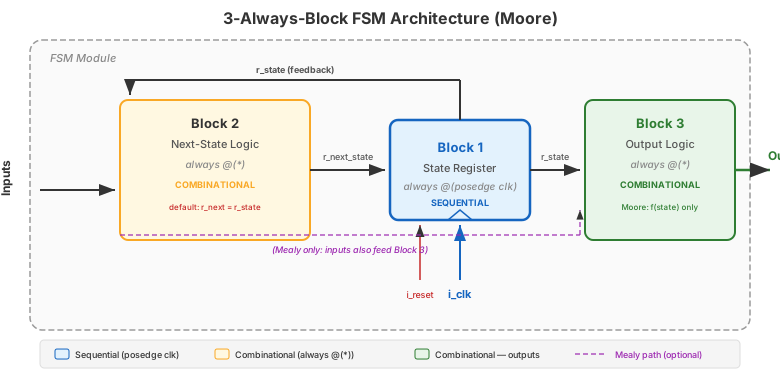
sequential ·
always @(posedge clk)combinational ·
always @(*)The 3-Block FSM Skeleton
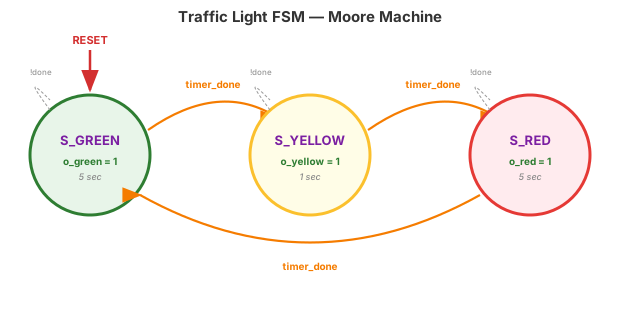
localparam GREEN = 2'd0, YELLOW = 2'd1, RED = 2'd2;
reg [1:0] state, next;

// Block 1: state register — sequential, the only @(posedge clk)
always @(posedge clk)
    if (rst) state <= GREEN;
    else     state <= next;

// Block 2: next-state logic — combinational, depends on state + inputs
always @(*) begin
    next = state;                                    // safe default — no latch
    case (state)
        GREEN:  if (green_timer_done)  next = YELLOW;
        YELLOW: if (yellow_timer_done) next = RED;
        RED:    if (red_timer_done)    next = GREEN;
    endcase
end

// Block 3: output logic — combinational, depends on state (Moore)
always @(*) begin
    {led_g, led_y, led_r} = 3'b000;                  // default
    case (state)
        GREEN:  led_g = 1'b1;
        YELLOW: led_y = 1'b1;
        RED:    led_r = 1'b1;
    endcase
end
Memorize this layout. Every FSM you write this course follows it.
Moore vs Mealy in One Slide
Moore
Outputs depend on state only.
- Glitch-free outputs (registered behavior)
- Easier to reason about, easier to verify
- Default choice for control FSMs
Mealy
Outputs depend on state + input.
- Fewer states needed
- Can output one cycle earlier
- Easy to introduce hazards — use deliberately
▸ Phase 3 of 5 · ~70 min · You build
🛠 Assemble
Diagram → table → code → board
Build Plan
- Ex 1 · 30 min Traffic light controller — 3 states, parameterized timers, LEDs on the Go Board.
- Ex 2 · 20 min Traffic light TB — verify the full cycle, timing, and reset behavior.
- Ex 3 · 20 min Pattern detector "1101" — Moore version. A state per bit of progress.
State Diagram → State Table → Code
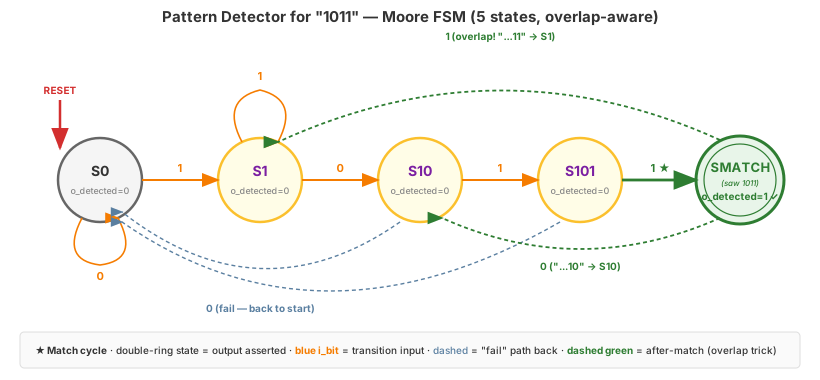
State table — pattern detector "1101"
| State | in=0 | in=1 | out |
|---|---|---|---|
| S0 | S0 | S1 | 0 |
| S1 | S0 | S2 | 0 |
| S2 (11) | S3 | S2 | 0 |
| S3 (110) | S0 | S4 | 0 |
| S4 (1101) | S0 | S1 | 1 |
From the table, the Verilog writes itself:
case (state)
    S0: next = in ? S1 : S0;
    S1: next = in ? S2 : S0;
    S2: next = in ? S2 : S3;
    S3: next = in ? S4 : S0;
    S4: next = in ? S1 : S0;
endcase
Output: found = (state == S4);
Traffic Light TB — State Coverage
// Use SHORT timers in sim — match the parameter name
traffic_light #(
    .GREEN_TIME(10), .YELLOW_TIME(5), .RED_TIME(15)
) dut (.clk(clk), .rst(rst), .led_g(g), .led_y(y), .led_r(r));

initial begin
    rst = 1; #20; rst = 0;
    // Expect GREEN for 10 cycles
    repeat (10) @(posedge clk);
    if ({g,y,r} !== 3'b100) $display("FAIL: not GREEN after rst");
    // Expect YELLOW for 5 cycles
    repeat (5)  @(posedge clk);
    if ({g,y,r} !== 3'b010) $display("FAIL: did not enter YELLOW");
    // Expect RED for 15 cycles
    repeat (15) @(posedge clk);
    if ({g,y,r} !== 3'b001) $display("FAIL: did not enter RED");
    // Back to GREEN
    @(posedge clk);
    if ({g,y,r} !== 3'b100) $display("FAIL: did not return to GREEN");
    $display("PASS"); $finish;
end
Notice the parameter override — same TB stays usable when you flash with the long hardware timers.
▸ Phase 4 of 5 · ~45 min · Verify · harden · critique AI
🛡 Fortify
Every state. Every transition. Both blocks reachable.
The FSM Verification Checklist
- State reachability: does every state get entered during the TB? If not, add stimulus.
- Transition coverage: every arrow in your diagram exercised at least once.
- Reset from every state: assert
rstmid-run, confirm return to the reset state. - Unreachable states are safe: hit
defaultincase— output should be benign, notX. - Timing: each state lasts exactly the expected number of cycles (use parameterized sim timers).
state, next, and inputs together — the diagram comes alive.
🤖 Check the Machine — FSM Prompt
Prompt: "Generate a Verilog FSM for a traffic light controller with a pedestrian button input that forces a quick yellow + red cycle. Use the 3-always-block pattern."
- Did it use 3 always blocks? Or did it cram everything into one
@(posedge clk)? - Is the next-state block latch-free? Look for a
next = state;default at the top. - Does the pedestrian button get debounced and synchronized? If not, that's a real-world bug — the AI's lab works only in sim.
- Refactor what's wrong, save the prompt + before/after to your portfolio.
state with a blocking assignment in @(posedge clk). That's a sim/synth mismatch waiting to bite you.
Hardware Verification
- Traffic light on the Go Board: LEDs cycle green → yellow → red at human-visible cadence. Phone-stopwatch the green duration — should match your parameter.
- Pattern detector: drive the input with a switch + button, press the sequence 1-1-0-1 — the "found" LED pulses for one cycle.
- False sequences do not trigger: 1-1-0-0, 1-0-1, 0-1-1-0-1 — all should stay dark.
▸ Phase 5 of 5 · ~10 min
🔗 Transfer
Carry it to HP this afternoon
At HP Barcelona This Afternoon
HP's Customer Center is about AI-assisted product workflows. The questions to bring:
- Where is AI assisting, not replacing? What decisions still belong to humans? (Same question you answered for your AI TB this morning.)
- How do they validate AI-generated outputs? Is there a "TB layer" for AI recommendations?
- What FSMs run their products? Print job scheduling · firmware update sequencing · power-state controllers — all FSMs.
Tomorrow → Hierarchy & Parameters
D8 is the day you stop copy-pasting modules. Parameters + generate let one module become an entire family.
You'll build a parameterized N-bit counter, instantiate it at 4 different widths, and start tracking PPA — area vs width — for real.
D8 prep tonight
- 📺 D8 video (~50 min — includes the new recursive-generate segment)
- 📝 D8 pre-class quiz
- 📝 HP reflection (1 page, due before D8)
🔗 End of Day 7 · HP Customer Center this afternoon
Three blocks. Three concerns. One FSM.
You can now translate a state diagram to working hardware and prove every transition.
Tomorrow we make those modules reusable.