Today at a Glance
| Phase | Time | Activity |
|---|---|---|
| 🌍 Contextualize | 10 min | IP libraries · Semidynamics' parameterized RISC-V cores |
| ⚠️ Reframe | 15 min | generate ≠ runtime loop · elaboration-time hardware |
| 🛠 Assemble | 70 min | Param N-bit counter · AI-assisted param TB · generate driver · hierarchical top |
| 🛡 Fortify | 45 min | Sweep WIDTH=4/8/16/32 · yosys stat PPA table · hardware verify |
| 🔗 Transfer | 10 min | Cooking workshop metaphor · D9 preview |
yosys stat table. This is what runs to Day 14.
▸ Phase 1 of 5 · ~10 min
🌍 Contextualize
Companies ship parameter families, not single modules
Why Companies Parameterize
- Semidynamics doesn't redesign their RISC-V core per customer — they ship one core with a configuration vector (vector width, cache size, port count).
- HP printers use the same firmware FSM across product tiers — features turn on with
generate if. - The Metro signal system uses one debouncer module — instantiated thousands of times with different thresholds per sensor.
The economic point
Parameters turn a module into a product line. One verified DUT covers a thousand SKUs.
Today you build your first parameter family. By Week 4 your whole project is parameterized.
▸ Phase 2 of 5 · ~15 min
⚠️ Reframe
When the loop runs matters more than what it does
⚠️ generate Is Not a Runtime Loop
❌ Wrong Model
"generate for (i=0; i<N; i++) is like a software for — it processes 4 things one at a time, fast."
✓ Right Model
generate for unrolls at synthesis time. N=4 creates four independent physical instances that all run in parallel on the same clock edge. The loop doesn't exist in the netlist.
generate Unrolls Into Hardware
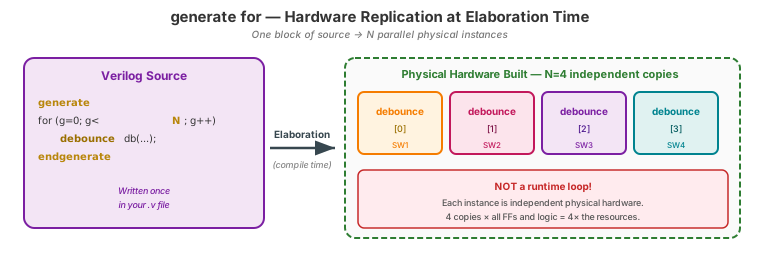
N copies of the body exist simultaneously in silicon.
Parameterized N-Bit Counter
module counter #(
    parameter WIDTH = 8
)(
    input  wire             clk, rst, en,
    output reg  [WIDTH-1:0] q,
    output wire             rollover
);
    assign rollover = (q == {WIDTH{1'b1}}) & en;

    always @(posedge clk) begin
        if (rst)     q <= 0;
        else if (en) q <= q + 1'b1;
    end
endmodule

// Instantiate three sizes from one module:
counter #(.WIDTH(4))  c4  (.clk(clk), .rst(rst), .en(en), .q(q4),  .rollover(r4));
counter #(.WIDTH(8))  c8  (.clk(clk), .rst(rst), .en(en), .q(q8),  .rollover(r8));
counter #(.WIDTH(16)) c16 (.clk(clk), .rst(rst), .en(en), .q(q16), .rollover(r16));
One module · three width-specific netlists. The synthesizer specializes each one.
generate for & generate if
// generate for: replicate hardware
genvar i;
generate
    for (i = 0; i < NUM_LEDS; i = i + 1) begin : g_blink
        blinker #(.PERIOD(1_000_000 * (i+1))) b
            (.clk(clk), .led(leds[i]));
    end
endgenerate

// generate if: include features conditionally
generate
    if (HAS_PARITY) begin : g_parity
        wire par = ^data;                 // XOR-reduce
        assign tx = {par, data};
    end else begin : g_no_parity
        assign tx = data;
    end
endgenerate: g_blink) keeps the hierarchy navigable in yosys show and GTKWave.
▸ Phase 3 of 5 · ~70 min · You build · across widths
🛠 Assemble
One module · four widths · one top
Build Plan
- Ex 1 · 20 min Parameterized counter — synth at WIDTH = 4, 8, 16, 32. Three instances in one top.
- Ex 2 · 🤖 25 min AI-assisted param TB — prompt AI to write a TB that overrides WIDTH and tests rollover at
2^WIDTH - 1. Critique & fix. - Ex 3 · 15 min
generate forLED driver — 4 blinkers, period scales with index. - Ex 4 · 10 min Hierarchical top — debouncer (D5) + counter (today) + 7-seg (D2) wired together.
🤖 AI-Assisted Param TB — The Prompt
Write a self-checking Icarus-compatible testbench for this counter module:

  module counter #(parameter WIDTH=8) (
    input clk, rst, en, output [WIDTH-1:0] q, output rollover);

Requirements:
  - Test WIDTH = 4, 8, and 16 in the SAME testbench using #(.WIDTH(N)) overrides
  - For each instance, verify rollover fires at q == (2**WIDTH - 1)
  - Verify reset clears q to 0 from any value
  - Verify en=0 freezes q
  - Use !== for comparisons, print PASS/FAIL summary, $finish at end
  - Target IEEE 1364-2005 Verilog (no SystemVerilog)
- Does the AI use
2**WIDTH - 1per instance, or hardcode 255? Hardcoding is the #1 failure mode. - Does it pass three independent DUTs, or one DUT three times? The whole point is separate netlists.
- Save prompt + correction to the AI portfolio.
Hierarchical Top — Composition Pays Off
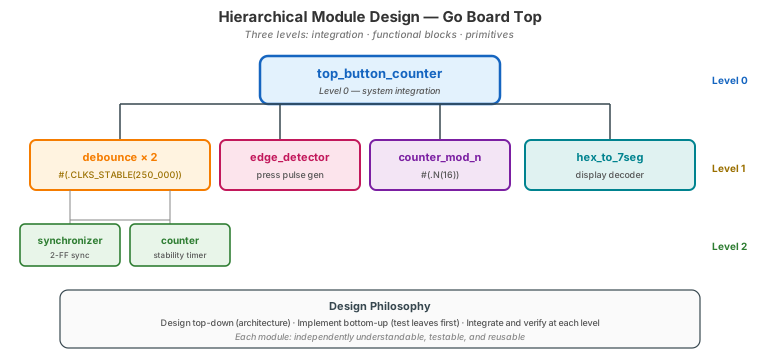
module lab_instrument (
    input  wire clk,
    input  wire btn_async,
    output wire [6:0] seg
);
    wire btn_clean, tick;
    wire [3:0] count;

    debouncer #(.THRESHOLD(250_000))      u_db   (.clk(clk), .in_async(btn_async),
                                                  .out_clean(btn_clean));
    counter   #(.WIDTH(4))                u_cnt  (.clk(clk), .rst(1'b0), .en(btn_clean),
                                                  .q(count), .rollover());
    hex_to_7seg                           u_disp (.hex(count), .seg(seg));
endmodule
Three modules. Three days of work. Composed in 10 lines. This is the payoff for hierarchy.
▸ Phase 4 of 5 · ~45 min · Verify · measure PPA · harden
🛡 Fortify
Make the synthesizer show you the cost
Width Sweep — Capture the Table
for W in 4 8 16 32; do
    yosys -p "read_verilog -DWIDTH=$W counter.v; \
              synth_ice40 -top counter; stat" \
          2>&1 | grep -E "SB_LUT4|SB_DFF"
done
Fill in the table together on the projector:
| WIDTH | SB_LUT4 | SB_DFF | Predicted |
|---|---|---|---|
| 4 | ? | ? | ~4 LUTs, 4 FFs |
| 8 | ? | ? | ~8 LUTs, 8 FFs |
| 16 | ? | ? | ~16 LUTs, 16 FFs |
| 32 | ? | ? | ~32 LUTs, 32 FFs |
The PPA Habit Starts Here
P — Power
More flip-flops ⇒ more switching ⇒ more dynamic power. (We'll quantify Day 10.)
P — Performance
Wider counter ⇒ longer carry chain ⇒ lower Fmax. (Day 10 measures this.)
A — Area
Today's table is your first Area data point. Keep it for the project report.
The thread
D3 seeded it · D8 formalizes the habit · D10 adds timing · D14 uses it to defend project choices.
Hardware Verification
- Hierarchical top: press the debounced button — 7-seg counts 0 → F → 0 cleanly. One press = one increment (the debouncer is doing its job).
generate forblinkers: all 4 LEDs blink at different rates from one module instantiation.- Wrong widths: deliberately wire the 4-bit counter to drive 7-seg expecting 8 bits — find the warning in the Yosys log. That's a hardware bug caught at synthesis.
▸ Phase 5 of 5 · ~10 min
🔗 Transfer
Take it to the kitchen tonight
Tonight: Cooking Workshop = HDL Metaphor
Software / single cook
- One recipe, one cook, one step at a time
- Step 2 starts when step 1 finishes
- This is your software
forloop
Hardware / multiple cooks
- Same recipe, four cooks, in parallel
- Veg chopper, pan watcher, sauce stirrer, plater — all at once
- This is your
generate for
Next: Catch-up Day → then Memory in Week 3
Thu 6/4 is a catch-up day — finish this week's labs and start scoping a project. Project selection is due Tue 6/9 (Week 3, D10 day). Fri 6/5 is free.
Week 3 opens with Memory (D9, Mon 6/8): ROM, RAM, and Block RAM inference. The iCE40's 16 EBR blocks are free, fast memory — but only if your code matches the inference pattern. You'll build a ROM-driven LED sequencer and a RAM with read-after-write verification.
Looking ahead
- 📝 Project selection due Tue 6/9 (6-option list)
- 📺 D9 Memory video (~45 min) — watch over the Fri–Sun weekend
- 🍷 Enjoy the cooking workshop · Friday is free
🔗 End of Day 8 · A la cocina!
One module. Every width. Zero copy-paste.
You can now build a parameter family and read its PPA cost from the synthesizer.
After the catch-up day and weekend, Week 3 opens with where the data lives.