Today at a Glance
| Phase | Time | Activity |
|---|---|---|
| 🌍 Contextualize | 10 min | Memory everywhere · the iCE40's 64 Kbit secret |
| ⚠️ Reframe | 15 min | Memory ≠ array · the EBR inference pattern |
| 🛠 Assemble | 70 min | ROM sequencer · inferred BRAM · RAW testbench · dual-port stretch |
| 🛡 Fortify | 45 min | Confirm SB_RAM40_4K · read-after-write coverage · 🤖 AI BRAM critique |
| 🔗 Transfer | 10 min | Re-ground in Weeks 1–2 · → D10 timing (tomorrow) |
▸ Phase 1 of 5 · ~10 min
🌍 Contextualize
Storage is in everything you've touched in Barcelona
Memory Runs the City
- BCN airport departure board — a frame buffer redrawn every second
- Metro line-map display on each train — a small ROM of station names
- T-Casual card readers — a per-card ride history in a tiny RAM
- Sagrada Família visitor counters — a saturating count, persisted
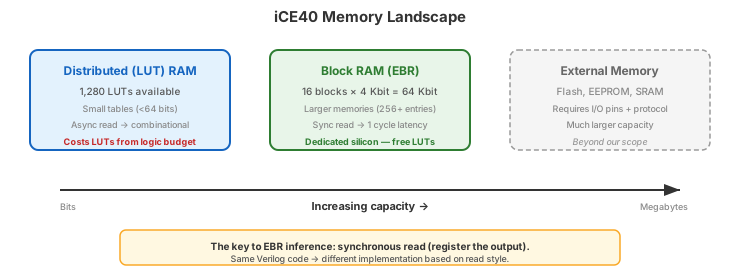
Today's iCE40 has 16 Block RAMs × 4 Kbits = 64 Kbits of fast, dedicated memory. Free — if your code asks for it correctly.
The penalty for asking wrong
Same 256×8 memory implemented as LUTs: ~2 048 SB_LUT4s. As EBR: 1 Block RAM. That's the difference between fitting on the chip and not.
▸ Phase 2 of 5 · ~15 min
⚠️ Reframe
Memory has physics. Code reflects it.
⚠️ Memory Is Not "Just an Array"
❌ Wrong Model
"reg [7:0] mem [0:255]; is just an array. I'll read and write it however I want."
✓ Right Model
Real memories have physical constraints: synchronous vs async read, port count, init mechanism. Coding patterns are recipes the synthesizer recognizes — match the recipe, get free EBR; miss it, burn LUTs.
SB_RAM40_4K. Combinational read ⇒ LUT RAM (or worse).
Synchronous vs. Asynchronous Read
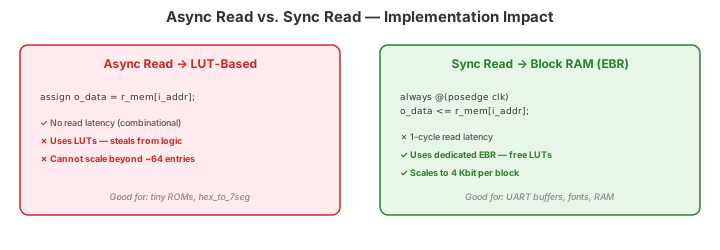
dout updated inside @(posedge clk)? This is the pattern you match in Ex 2.
The EBR Inference Pattern
module bram #(
    parameter ADDR_WIDTH = 8,
    parameter DATA_WIDTH = 8
)(
    input  wire                       clk,
    input  wire                       we,
    input  wire [ADDR_WIDTH-1:0]      addr,
    input  wire [DATA_WIDTH-1:0]      din,
    output reg  [DATA_WIDTH-1:0]      dout      // ← reg, registered
);
    reg [DATA_WIDTH-1:0] mem [0:(1<<ADDR_WIDTH)-1];

    always @(posedge clk) begin
        if (we) mem[addr] <= din;
        dout <= mem[addr];                       // ← READ inside @(posedge clk)
    end
endmoduledoutisreg· the read is sequential · Yosys can map this toSB_RAM40_4K- One
alwaysblock for both ports — the standard "no read-during-write" pattern
⚠️ The Combinational-Read Trap
// ❌ This LOOKS efficient. It is not.
reg [7:0] mem [0:255];
assign dout = mem[addr];           // combinational read

always @(posedge clk)
    if (we) mem[addr] <= din;
// ✓ Synchronous read — Yosys can map to EBR
always @(posedge clk) begin
if (we) mem[addr] <= din;
dout <= mem[addr];
endyosys stat after writing memory code.
▸ Phase 3 of 5 · ~70 min · You build
🛠 Assemble
ROM · RAM · TB · stretch
Build Plan
- Ex 1 · 25 min ROM-driven pattern sequencer — write a
.hex, load with$readmemh, step a counter through addresses, drive LEDs & 7-seg. - Ex 2 · 25 min Inferred Block RAM — 256×8 BRAM. Synthesize and confirm
SB_RAM40_4Kappears inyosys stat. - Ex 3 · 20 min RAM testbench — read-after-write, overwrite, read from unwritten address.
ROM From a Hex File
module rom_seq #(
    parameter INIT_FILE = "patterns.hex"
)(
    input  wire       clk,
    input  wire [3:0] addr,
    output reg  [7:0] data
);
    reg [7:0] mem [0:15];

    initial $readmemh(INIT_FILE, mem);     // synthesizable in Yosys/iCE40

    always @(posedge clk) data <= mem[addr];   // registered read
endmodule
patterns.hex (one byte per line):
01
03
07
0F
1F
3F
7F
FF
...
Drive addr from a slow counter — LEDs trace the pattern at human speed.
RAM TB — Read-After-Write
// Self-checking pattern: write N, read back, verify
task automatic check (input [7:0] addr_i, input [7:0] data_i);
    begin
        @(posedge clk); we <= 1; addr <= addr_i; din <= data_i;
        @(posedge clk); we <= 0;                  // 1 cycle latency
        @(posedge clk);                            // capture
        if (dout !== data_i) begin
            $display("FAIL: wrote %02h at %02h, read %02h", data_i, addr_i, dout);
            fails = fails + 1;
        end
        tests = tests + 1;
    end
endtask

initial begin
    fails = 0; tests = 0;
    check(8'h00, 8'hA5);
    check(8'h01, 8'h5A);
    check(8'hFF, 8'hC3);
    check(8'h00, 8'h12);   // overwrite addr 0
    if (fails == 0) $display("PASS: %0d tests", tests);
    else            $display("FAIL: %0d/%0d", fails, tests);
    $finish;
end
Note the 2-cycle latency — write on edge 1, dout valid on edge 3. This is what "synchronous read" means.
▸ Phase 4 of 5 · ~45 min · Confirm EBR · sweep · AI check
🛡 Fortify
Trust the synth report, not the source
Confirm Block RAM Inference
yosys -p "synth_ice40 -top bram; stat" bram.v 2>&1 \
    | grep -E "SB_RAM|SB_LUT4|SB_DFF"
✓ Wanted output
SB_RAM40_4K  1
SB_LUT4      ~30
SB_DFF       ~8
❌ Inference miss
SB_RAM40_4K  0
SB_LUT4      2048
SB_DFF       8
dout is declared wire instead of reg. Fix and re-synth.
🤖 Check the Machine — BRAM Prompt
Prompt: "Write a dual-port RAM in Verilog for the Lattice iCE40 that Yosys will infer as Block RAM."
- Did the AI declare both
doutoutputs asreg? Many fall back toassign dout = mem[addr];(combinational) — kills EBR inference. - Does it use one
always @(posedge clk)per port? The iCE40 EBR has two independently clocked ports. - Does it instantiate
SB_RAM40_4Kdirectly? If so — politely refuse. We want inference, not hard instantiation. Inferred code is portable; the primitive isn't. - Run
yosys staton the AI's code and your own. Compare. Save to portfolio.
Hardware Verification
- ROM sequencer: patterns from
patterns.hexappear on LEDs / 7-seg at the expected cadence. Change the hex file, re-synth, see new pattern. - BRAM: write a value via buttons, change address, write another, read back the first — both values survive. Persistence is the point.
- Wrong inference is invisible from the LED: the design still works with LUT RAM — it just costs 20× more area.
yosys statis the only honest check.
▸ Phase 5 of 5 · ~10 min · Week 3 opens
🔗 Transfer
Where we left off, and where memory takes you
Where We Left Off — Weeks 1–2
Back from the catch-up day, free Friday, and weekend — here's the foundation memory builds on:
W1 Hardware thinking · data types · combinational logic · clocked logic & RTL.
D5+D6 Counters · shift registers · debouncing · self-checking + 🤖 AI testbenches. Semidynamics.
D7 FSMs · 3-block pattern · Moore & Mealy. HP Customer Center.
D8 Hierarchy · parameters · generate · first PPA width sweep. Cooking workshop.
D9 ROM, RAM & Block RAM inference. You can now describe any synchronous digital subsystem.
Tomorrow → D10 Timing & Numerical Architectures
Tue 6/9 brings setup, hold, Fmax, and PPA — the constraints that turn working code into shippable silicon. Plus numerical architectures: adders, shift-add multipliers, fixed-point.
Bring your D8 PPA table — we'll add a timing column. Eve: Flamenco.
Tonight
- 📺 D10 video (~55 min — denser than usual)
- 📝 D10 pre-class quiz
- 🛠 Lock in your project selection — due tomorrow (Tue 6/9)
🔗 End of Day 9 · Week 3 is underway
Counters. States. Memory. Done.
You can now design any synchronous subsystem — and verify it both manually and with AI.
This week: timing, then UART — your first communication protocol.