Today at a Glance
| Phase | Time | Activity |
|---|---|---|
| 🌍 Contextualize | 10 min | Serial everywhere · Go Board USB-UART · Semidynamics debug |
| ⚠️ Reframe | 15 min | There is no print() · FSM + PISO + baud counter |
| 🛠 Assemble | 70 min | UART TX (sim) · single char on button · "HELLO" string · hex-to-ASCII stretch |
| 🛡 Fortify | 45 min | Waveform vs spec · scope/logic-analyzer the wire · 🤖 protocol-aware TB |
| 🔗 Transfer | 10 min | RX preview · Park Güell bridge · project build day next |
▸ Phase 1 of 5 · ~10 min
🌍 Contextualize
Every chip you've touched in Barcelona talks serial
Serial Is Everywhere
- Your Go Board — the USB cable in your laptop right now is hosting a USB-to-UART bridge. Today you put real bytes on it.
- Semidynamics RISC-V chips — every silicon bring-up starts with a UART debug port. No UART, no boot log, no chip.
- Barcelona Metro telemetry — train-to-trackside status uses serial protocols layered on top of UART-style framing.
- HP printers — head/cartridge handshake = a tiny embedded UART.
The hardware engineer's first ritual
Power on the chip → wire up TX/RX → open a terminal → see boot…. That's the moment your design is alive. Today you build the transmitter half of that ritual.
UART is 50 years old. It's the most-deployed protocol on Earth that isn't TCP/IP. You're learning the lingua franca.
▸ Phase 2 of 5 · ~15 min
⚠️ Reframe
There is no print(). There is a shift register.
⚠️ "Just Send a String"
❌ Wrong Model
"printf("HELLO"). Done. The hardware will figure it out."
✓ Right Model
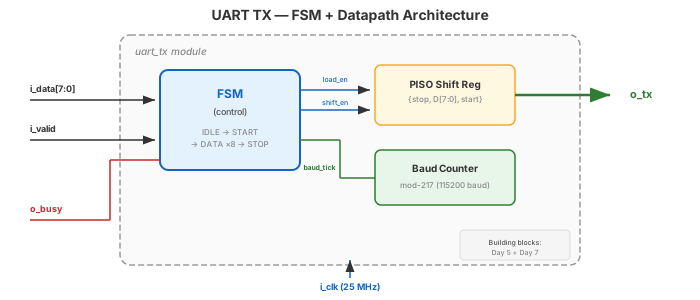
You are building, in silicon, the thing that implements print: a baud counter + bit counter + PISO shift register + 5-state FSM. There is no software underneath.
The Four Blocks Inside "print"
The Frame on the Wire
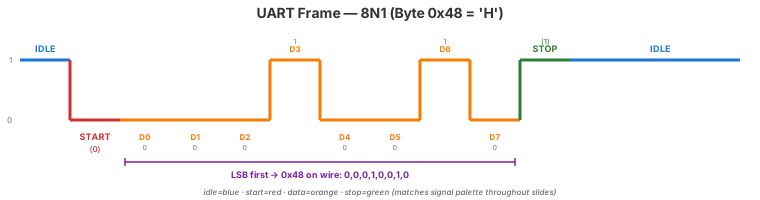
  IDLE   START   D0   D1   D2   D3   D4   D5   D6   D7   STOP   IDLE
   1       0     b0   b1   b2   b3   b4   b5   b6   b7    1      1
  ─────┐  ┌──┐  ┌──┐ ┌──┐ ┌──┐ ┌──┐ ┌──┐ ┌──┐ ┌──┐ ┌──┐  ┌────────
       │  │  │  │  │ │  │ │  │ │  │ │  │ │  │ │  │ │  │  │
       └──┘  └──┘  └─┘  └─┘  └─┘  └─┘  └─┘  └─┘  └─┘  └──┘
                ◀──────────── 8 data bits, LSB first ────────────▶
- IDLE = line high. Always.
- START = 1 bit-period low. The falling edge is the receiver's only synchronization point — it sets the clock for the whole frame.
- DATA = 8 bits, LSB first. (This is the bug everyone hits at least once.)
- STOP = 1 bit-period high. Returns the line to idle.
Baud Math
// 25 MHz Go Board clock
// 115200 baud
parameter CLKS_PER_BIT = 25_000_000 / 115_200;
//                     = 217.01… ≈ 217
Actual baud = 25e6 / 217 = 115,207 Hz. Error = 0.006%. Well within the ±5% UART tolerance.
Common rates @ 25 MHz
| Baud | CLKS_PER_BIT |
|---|---|
| 9600 | 2604 |
| 19200 | 1302 |
| 57600 | 434 |
| 115200 | 217 |
parameter CLKS_PER_BIT means it's a parameter override.
▸ Phase 3 of 5 · ~70 min · You build
🛠 Assemble
Sim first · then "HELLO" on your laptop
Build Plan
- Ex 1 · 40 min UART TX in simulation — FSM (IDLE → START → DATA → STOP) + baud counter + bit counter. Testbench at
CLKS_PER_BIT=4for fast sim. Verify the 'A' (0x41) frame in GTKWave. - Ex 2 · 20 min Single character on button — debounce (reuse D5 module), drive
tx_data='A', pulsetx_start, routetx_outto the pin. Open terminal → see 'A'. - Ex 3 · 25 min "HELLO\r\n" — 7-byte ROM + sequencer FSM that waits for
tx_busylow before advancing.
0A\r\n", "0B\r\n". Dropped from required: UART RX (pre-class video covers it) · SPI master.
The TX FSM — IDLE → START → DATA → STOP
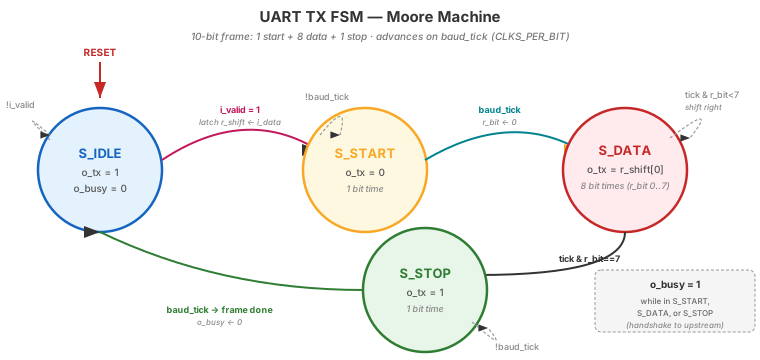
CLKS_PER_BIT cycles before advancing. The DATA state loops 8 times, one bit per period. This is the FSM the skeleton below implements.
UART TX (Skeleton)
module uart_tx #(parameter CLKS_PER_BIT = 217) (
    input  wire       clk, rst,
    input  wire       tx_start,
    input  wire [7:0] tx_data,
    output reg        tx_out,
    output reg        tx_busy
);
    localparam IDLE=3'd0, START=3'd1, DATA=3'd2, STOP=3'd3;
    reg [2:0]  state;
    reg [15:0] baud_cnt;
    reg [2:0]  bit_idx;
    reg [7:0]  data_latched;

    always @(posedge clk) begin
        if (rst) begin state <= IDLE; tx_out <= 1; tx_busy <= 0; end
        else case (state)
            IDLE:  begin tx_out <= 1; tx_busy <= 0;
                         if (tx_start) begin
                             data_latched <= tx_data; tx_busy <= 1;
                             baud_cnt <= 0; state <= START;
                         end end
            START: begin tx_out <= 0;                       // start bit
                         if (baud_cnt == CLKS_PER_BIT-1) begin
                             baud_cnt <= 0; bit_idx <= 0; state <= DATA;
                         end else baud_cnt <= baud_cnt + 1; end
            DATA:  begin tx_out <= data_latched[bit_idx];   // LSB first
                         if (baud_cnt == CLKS_PER_BIT-1) begin
                             baud_cnt <= 0;
                             if (bit_idx == 7) state <= STOP;
                             else              bit_idx <= bit_idx + 1;
                         end else baud_cnt <= baud_cnt + 1; end
            STOP:  begin tx_out <= 1;                       // stop bit
                         if (baud_cnt == CLKS_PER_BIT-1) state <= IDLE;
                         else baud_cnt <= baud_cnt + 1; end
        endcase
    end
endmodule
"HELLO" Sequencer
// 7-byte ROM in initial
reg [7:0] msg [0:6];
initial begin
    msg[0]="H"; msg[1]="E"; msg[2]="L";
    msg[3]="L"; msg[4]="O"; msg[5]="\r"; msg[6]="\n";
end

// Walk the ROM, wait for !tx_busy between bytes
always @(posedge clk) case (s)
    LOAD: begin tx_data <= msg[idx]; tx_start <= 1; s <= WAIT; end
    WAIT: begin tx_start <= 0;
                if (!tx_busy && tx_busy_d) begin           // falling edge
                    if (idx == 6) s <= DONE;
                    else begin idx <= idx + 1; s <= LOAD; end
                end end
endcasetx_start while tx_busy is still high. The TX engine ignores you and your second byte never goes out. Always wait for the falling edge of tx_busy.
▸ Phase 4 of 5 · ~45 min · Sim · scope · AI
🛡 Fortify
If the terminal shows garbage, the bug is timing
Waveform vs Spec — Check Every Bit
- IDLE — line high for at least 1 cycle before
tx_start. - START — line low for exactly
CLKS_PER_BITcycles. Measure in the waveform. - DATA bit 0 first — for 'A' =
0x41=0100_0001, the order on the wire is1,0,0,0,0,0,1,0. - STOP — line high for one full bit period. Then
tx_busydrops. - Total frame = 10 ×
CLKS_PER_BITcycles, start to stop end.
CLKS_PER_BIT, (b) MSB instead of LSB, or (c) terminal set to 9600 when you're sending 115200.
🤖 Check the Machine — Protocol-Aware TB
Prompt: "Write a Verilog testbench for a UART TX module with CLKS_PER_BIT=4. The TB should verify start bit, 8 data bits LSB-first, stop bit, busy semantics, and back-to-back transmissions. Use self-checking with PASS/FAIL output."
- Did it measure bit duration? Many AI TBs just check value, not duration. A frame that's the right bits at the wrong rate is a fail in the real world.
- Did it check LSB-first? Watch for an MSB-first assumption — it'll silently "pass" wrong code.
- Did it test back-to-back TX? The
tx_busycontract only matters when you push two bytes in a row. - Annotate corrections, save to portfolio. This is the kind of protocol-aware testbench your project's verification builds on.
Hardware Verification
- Single char: button → 'A' on terminal. Hold the button — does it spam or pulse once? (Debouncer test.)
- "HELLO": press → "HELLO\r\n" appears. Press again — second copy appears on a new line. Now you have a printer.
- Scope/logic analyzer the TX line (if available) — measure 115.2 kHz bit rate directly. Confirm your math.
- Mismatch demo — set the terminal to 9600 baud. Same "HELLO" press. Watch the garbage. Now you've felt a baud mismatch in your bones.
▸ Phase 5 of 5 · ~10 min · Park Güell · then build your project
🔗 Transfer
Protocols generalize. This afternoon: Gaudí's modular tiles.
Where This Goes
Tomorrow (Thu 6/11): a structured project build + lab catch-up day. Your UART skills go straight into your project — integrate, debug, and start the core module.
Project use: Option 1 (UART Command Parser) is a direct extension of today. Even projects that don't need TX get a debug UART for free.
This afternoon: Park Güell
- 🦎 Gaudí's tilework is a modular, parameterized system — the same tile repeated with variation, exactly like your
parameter CLKS_PER_BITandgenerateblocks. - 🛠 No new video — tomorrow is hands-on project time. Keep your core module moving toward the Thu 6/11 milestone.
🔗 End of Day 11 · Olé
You printed "HELLO" from silicon.
No software underneath.
FSM + counter + shift register + a parameter for baud.
Tomorrow: a project build day — put it all to work.