🌍 Where This Lives
Where it shows up
Anywhere two clocks meet. Your finger presses a key whenever it feels like it, but the chip inside the keyboard ticks at 100MHz. A Bluetooth packet arrives on the radio's clock and needs to land in the CPU's. Your laptop's CPU, GPU, memory bus, USB controller, and WiFi radio all keep their own time — and they hand each other signals millions of times a second.
When it goes wrong
The fault is invisible. It doesn't appear on the schematic. It doesn't appear in simulation. The chip works on the bench all afternoon. Then a customer ships ten thousand units and one in five locks up after eleven hours. Every senior FPGA/ASIC engineer has a story about chasing this for weeks. Every chip vendor's errata sheet has a paragraph about it.
⚠️ Real Silicon Doesn't Care About Your Simulator
❌ Wrong Model
“Flip-flops output 0 or 1 on every clock edge. My testbench always shows clean transitions. Asynchronous inputs work fine in simulation.”
✓ Right Model
Real flip-flops have setup and hold time windows around the clock edge. If an input changes during that window, the flop's output goes into a metastable state — neither 0 nor 1 — and may oscillate, decay slowly, or resolve randomly. Simulators don't model this. Your waveform will be clean while your real chip glitches once a week.
The Setup / Hold Window
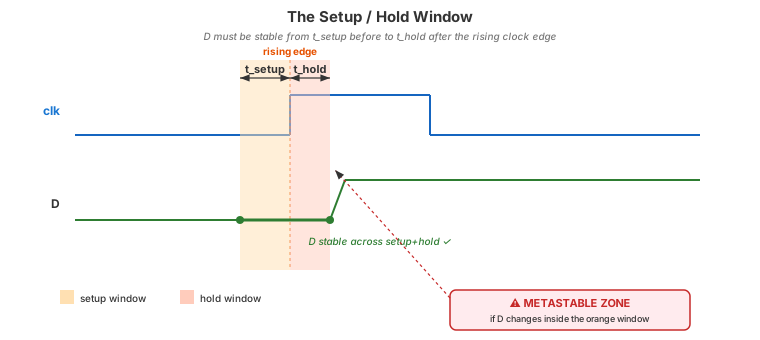
If D changes during the setup/hold window, the flop's output becomes metastable — stuck between 0 and 1 — until it resolves (probabilistically).
👁️ I Do — The 2-FF Synchronizer
module synchronizer (
    input  wire i_clk,
    input  wire i_async_in,    // from external world, any timing
    output wire o_sync_out     // clean, synchronous to i_clk
);
    reg r_meta, r_sync;
    always @(posedge i_clk) begin
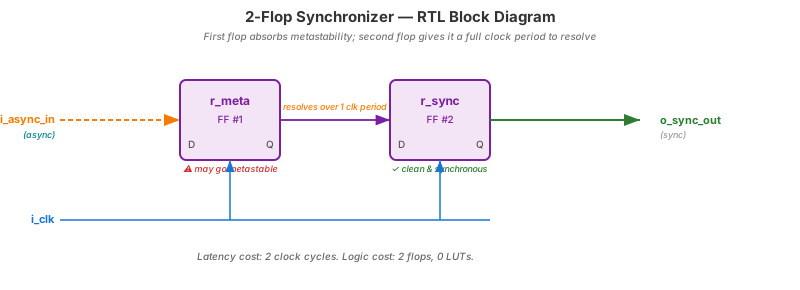
        r_meta <= i_async_in;  // first flop: may go metastable
        r_sync <= r_meta;      // second flop: has a full clock period to resolve
    end
    assign o_sync_out = r_sync;
endmodule🔧 2-FF Synchronizer — RTL View
🤝 We Do — When To Synchronize
Does this input need a synchronizer?
- A push button wired to an FPGA pin
- The output of a Topic 4 counter feeding a comparator
- UART RX line from a USB-serial chip
- A register's output feeding an ALU
- A signal from another FPGA running on a different crystal
🧪 You Do — Spot the Bug
module reader (
    input wire clk, async_ready, async_data,
    output reg captured
);
    always @(posedge clk)
        if (async_ready) captured <= async_data;
endmodule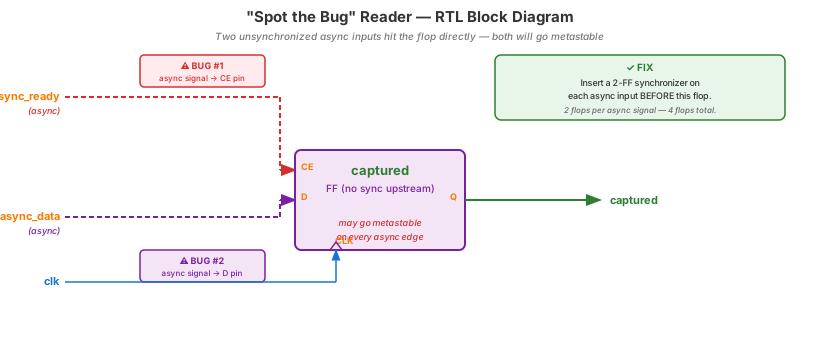
Find the metastability bugs.
async_ready and async_data) are asynchronous and feed flops directly. Need synchronizers on each. Worse: using async_ready as both a clock-enable and a mux select creates a risk of capturing async_data mid-transition even if it were synchronized. Fix: synchronize both signals through 2-FF synchronizers first, then use them.
Synchronizer on an Asynchronous Button
~4 minutes
▸ COMMANDS
cd lecture_examples/week2_day05/d05_s3_ex3/
make sim
make wave
make stat
▸ EXPECTED STDOUT
PASS: synced follows async
      with 2-cycle latency
PASS: glitches on async do
      not propagate
=== 10 passed, 0 failed ===

  SB_DFF: 2
▸ GTKWAVE
Signals: i_async_in · r_meta · r_sync. Note: r_meta may glitch in simulation (if the TB drives pulses shorter than the clock period); r_sync is always clean. Latency is 2 clock cycles. That's the cost of safety.
🧪 Can We Emulate Metastability?
Standard Verilog simulators model flops as ideal — they snap to 0 or 1 every edge. So real metastability can't be observed in a vanilla testbench. But we can emulate the consequences in several useful ways:
① Race the clock (TB)
Drive the async input with edges placed at deliberately bad offsets — e.g., 1 ps before/after the rising clock. With non-zero #delay on the assignment, many simulators will issue a timing violation warning and the unsynchronized flop captures the old value while the synchronizer's downstream flop sees something consistent. Useful for visualizing latency, not the metastable analog state itself.
② Inject randomness (TB)
When a setup/hold violation is detected, force the flop's Q to $urandom % 2 for one cycle. This emulates the “flop resolves to either value, randomly.” Run the testbench 10,000× and watch downstream FSMs misbehave without a synchronizer — and behave correctly with one.
③ Use 'X' propagation
Drive the async input as 1'bx for one cycle around the violation point. The first flop captures X; if the design doesn't synchronize, X propagates through downstream logic and lights up the waveform. SystemVerilog's $asserton and assertion-based verification (Topic 9) make this systematic.
④ Gate-level + SDF
Post-synthesis simulation with SDF (Standard Delay Format) back-annotation and specify blocks does model setup/hold checks. Violations produce X on the flop output until the next stable edge. This is the closest free simulators get to real silicon behavior — the industry-standard pre-tapeout signoff flow.
🔧 What Did the Tool Build?
$ yosys -p "read_verilog day05_ex03_synchronizer.v; synth_ice40 -top synchronizer; stat" -q

=== synchronizer ===
   Number of wires:                  4
   Number of cells:                  2
     SB_DFF                          2    ← exactly 2 flops, no frills
SB_LUT4 0(* ASYNC_REG="TRUE" *) attributes.
🤖 Check the Machine
Ask AI: “I'm reading a button press directly into my Verilog state machine. Do I need a synchronizer? Calculate MTBF with and without one for a 25 MHz clock.”
TASK
Ask AI about sync + MTBF.
BEFORE
Predict: without sync, MTBF ~hours-days. With 2FF sync, MTBF ~centuries.
AFTER
Strong AI shows the MTBF formula. Weak AI handwaves “it's fine” — dangerous advice.
TAKEAWAY
Any AI that says “buttons don't need synchronizers” is wrong. Don't trust that model for RTL work.
Key Takeaways
① Asynchronous signals + setup/hold violations = metastability.
② The 2-FF synchronizer gives metastability time to resolve.
③ Every external input and clock-domain crossing needs one.
④ Cost: 2 flops, 2 cycles latency. Cheap insurance.
🔗 Transfer
Button Debouncing
Video 4 of 4 · ~10 minutes
▸ WHY THIS MATTERS NEXT
Synchronization handles metastability — but buttons have a second problem: they bounce mechanically for up to 20 ms. At 25 MHz that's 500,000 false edges per press. Video 4 combines the synchronizer you just saw with a counter-based debouncer to build the complete input pipeline you'll use everywhere.