🌍 Where This Lives
Where it shows up
At Intel, AMD, Qualcomm, ARM — every internal style guide mandates one specific structural pattern for control logic, and every static-analysis tool (Spyglass, Lint, Design Compiler) flags deviations. Senior reviewers scan the structure before they read the logic. If the structure is wrong, the review stops there. The pattern is so widespread it works as a calling card: engineers can spot each other's training in five seconds.
When it goes wrong
“Works in sim, broken in silicon” is the most expensive sentence an engineer can write in an email. Almost every instance traces back to two things that should have been kept apart — present and next, combinational and sequential — getting blurred into a single line of code. The bug is not reproducible. It does not show in code review. It passes simulation. It appears once, in the field, on a customer's device.
⚠️ Why Not Write It All in One Block?
❌ Wrong Model
“I'll just use one big always @(posedge clk) that does state transitions, state register, and output logic all together. Fewer blocks = cleaner code.”
✓ Right Model
Three blocks separate three different concerns: (1) state register (how state persists), (2) next-state logic (how state changes), (3) output logic (what state produces). Mixing these in one block mixes blocking/nonblocking, creates subtle latches, and makes the circuit hard to reason about. The template exists because engineers have broken FSMs every other way first.
👁️ I Do — Block 1: State Register
State Reg
Next-State
Outputs
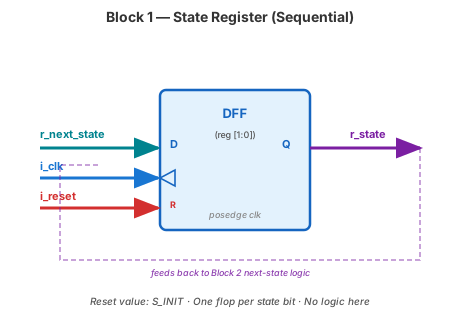
// --- Block 1: state register ---
always @(posedge i_clk) begin
    if (i_reset) r_state <= S_INIT;
    else         r_state <= r_next_state;
end
🤝 We Do — Block 2: Next-State Logic
State Reg
Next-State
Outputs
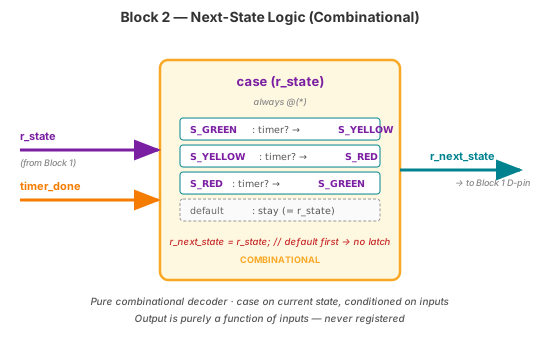
// --- Block 2: next-state logic (combinational) ---
always @(*) begin
    r_next_state = r_state;            // DEFAULT: stay (no latch)
    case (r_state)
        S_GREEN:  if (timer_done) r_next_state = S_YELLOW;
        S_YELLOW: if (timer_done) r_next_state = S_RED;
        S_RED:    if (timer_done) r_next_state = S_GREEN;
        default:                  r_next_state = S_INIT;   // illegal-state safety
    endcase
end
- Default assignment first:
r_next_state = r_state;— prevents latch inference and means “if no transition fires, stay put.” defaultcase at end: recovers from illegal states. For a 2-bit state with only 3 legal values, the 4th is unreachable in theory, but silicon glitches happen in practice.
🤝 We Do — Block 3: Output Logic (Moore)
State Reg
Next-State
Outputs
// --- Block 3: output logic (Moore: f(state) only) ---
always @(*) begin
    // defaults for ALL outputs (no latches)
    o_red    = 1'b0;
    o_yellow = 1'b0;
    o_green  = 1'b0;

    case (r_state)
        S_GREEN:  o_green  = 1'b1;
        S_YELLOW: o_yellow = 1'b1;
        S_RED:    o_red    = 1'b1;
        default: ;  // all off
    endcase
end
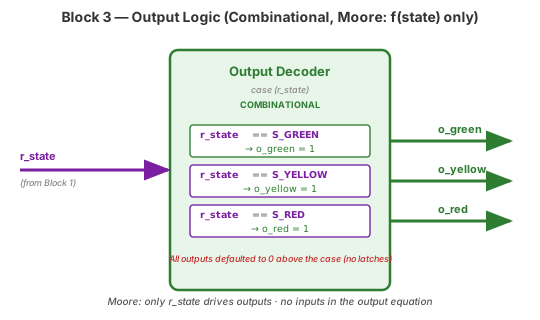
default: case at end. Same discipline, same reasons, same template. Moore = outputs depend only on r_state; Mealy = outputs also depend on inputs, but the structure stays identical.
🧪 You Do — Spot the Bug
State Reg
Next-State
Outputs
always @(*) begin
    case (r_state)
        S_GREEN:  begin r_next_state = S_YELLOW; o_green = 1; end
        S_YELLOW: begin r_next_state = S_RED;                 end
        S_RED:    begin r_next_state = S_GREEN;  o_red   = 1; end
    endcase
end
Three bugs. Find them.
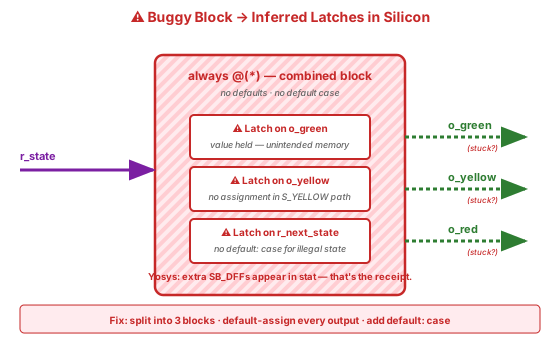
- Combined blocks: state and output logic are in the same
alwaysblock — violates the template. - No defaults: o_green, o_yellow, o_red aren't assigned in every branch → latch inference.
- No
default:case: if r_state takes an illegal value, r_next_state isn't assigned → another latch, plus no recovery.
Traffic Light FSM — From Diagram to Working Chip
~6 minutes
▸ COMMANDS
cd lecture_examples/week2_day07/d07_s2_ex1/
cat day07_ex01_fsm_template.v   # see 3-block template
make sim             # self-check
make wave            # see sequence
make stat            # check LUT count
make prog            # flash Go Board
▸ EXPECTED STDOUT
PASS: After reset: GREEN
PASS: GREEN->YELLOW
PASS: YELLOW->RED
PASS: RED->GREEN (cycle 2)
PASS: Mid-cycle reset -> GREEN
=== 5 passed, 0 failed ===
▸ GTKWAVE
Signals: r_state · o_red · o_yellow · o_green · timer_done. Watch state cycle GREEN → YELLOW → RED → GREEN while outputs change in lockstep with state (pure Moore: output = f(state)).
🔧 What Did the Tool Build?
$ yosys -p "read_verilog day07_ex01_fsm_template.v; synth_ice40 -top traffic_light; stat" -q

=== traffic_light ===  (3 states, binary encoded → 2 bits)
   Number of wires:                 10
   Number of cells:                  7
     SB_DFF                          2    ← 2 bits of state
     SB_LUT4                         5    ← next-state + output decode
$clog2(3) = 2 bits). 5 LUTs for all the combinational logic (next-state + output). Seven cells total for a complete traffic-light controller. That's the efficiency of a well-written FSM on an FPGA.
🤖 Check the Machine
Ask AI: “Write a vending-machine FSM using the 3-block template: states IDLE, COIN_IN, DISPENSE, RETURN_CHANGE. Include all defaults and default cases.”
TASK
Ask AI for a 3-block FSM with 4 states.
BEFORE
Predict: 3 separate always blocks, defaults at top, default case at end.
AFTER
Strong AI uses localparam for states + has defaults. Weak AI uses magic numbers.
TAKEAWAY
If AI skips the output defaults, it'll synth with latches. Catch it before synth does.
Key Takeaways
① Three blocks: state register, next-state logic, output logic.
② Block 1 is trivial. Block 2 defaults to “stay.” Block 3 defaults outputs.
③ Every case has a default:. Every output has a default assignment.
④ This template prevents the three most common FSM bugs.
🔗 Transfer
State Encoding
Video 3 of 4 · ~8 minutes
▸ WHY THIS MATTERS NEXT
Your traffic light FSM had 3 states and used 2 state bits. Is that optimal? What if you used 3 bits with one-hot encoding? Video 3 shows you the tradeoff and the Yosys output that proves it. This is one of the few Verilog decisions that visibly changes silicon cost.