🌍 Where This Lives
Where it shows up
In aerospace, a single cosmic-ray-induced bit flip can crash a flight computer. In a medical device, a glitch on an output line can deliver a wrong dose. In a car, a 30-nanosecond pulse on the airbag firing line can deploy at 70mph for no reason at all. The exact bit-pattern an engineer chooses to label “step 3 of the wash cycle” or “configuration A” is not a stylistic choice. It is a safety choice.
When it goes wrong
Mariner 1 was destroyed 293 seconds after launch because of a single character missing in a guidance equation. Multiple automakers have recalled airbag controllers after EMI glitches caused phantom deployments. Therac-25 had encoded its operating modes such that a single corruption could push it into a mode it should never have been able to reach. Same machine, same logic, different bit-pattern: different outcome under noise.
⚠️ Three Encodings, Three Optima
| Encoding | Bits (N states) | Example (4 states) | Best for |
|---|---|---|---|
| Binary | $clog2(N) | 00, 01, 10, 11 | ASIC, small FPGA, many states |
| One-Hot | N | 0001, 0010, 0100, 1000 | FPGA, fast decode, few states |
| Gray | $clog2(N) | 00, 01, 11, 10 | clock-domain-crossing FSMs |
👁️ I Do — Write It With localparam
// Use localparam for state names — never magic numbers
localparam [1:0] S_GREEN  = 2'd0;
localparam [1:0] S_YELLOW = 2'd1;
localparam [1:0] S_RED    = 2'd2;

reg [1:0] r_state, r_next_state;

always @(*) begin
    r_next_state = r_state;
    case (r_state)
        S_GREEN:  if (timer_done) r_next_state = S_YELLOW;
        S_YELLOW: if (timer_done) r_next_state = S_RED;
        S_RED:    if (timer_done) r_next_state = S_GREEN;
        default:                  r_next_state = S_GREEN;
    endcase
end
![Binary encoding RTL: 2 DFFs hold r_state[1:0]; next-state logic on the left; output decoder on the right produces o_green/o_yellow/o_red](diagrams/d07_binary_encoding_rtl.svg)
localparam names. Don't use 2'd1 scattered in your code — the compiler lets you, but no human can read it. Yosys's fsm_recode pass will convert to the optimal encoding at synthesis time anyway.
🤝 We Do — Convert to One-Hot
// One-hot encoding: N bits, only one high at a time
localparam [2:0] S_GREEN  = 3'b001;
localparam [2:0] S_YELLOW = 3'b010;
localparam [2:0] S_RED    = 3'b100;

reg [2:0] r_state, r_next_state;

// Same next-state structure — only the encoding changed
// Outputs become single-wire taps:
assign o_green  = r_state[0];
assign o_yellow = r_state[1];
assign o_red    = r_state[2];
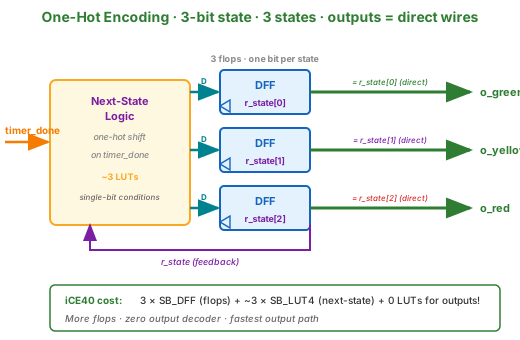
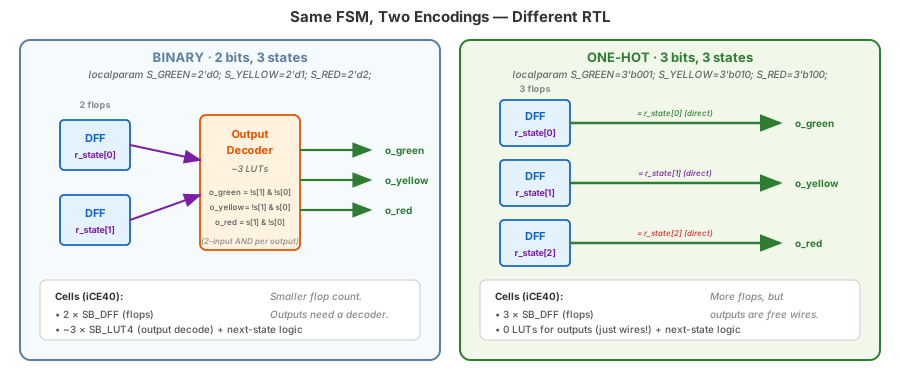
case structure is identical. The output logic gets faster because, e.g., o_green = r_state[0] — a single wire, no decoder. That's the one-hot win.
🔍 Encoding → RTL Impact
Same FSM. Different encoding. The shape of the hardware changes.
⚙️ What the Tool Does Behind Your Back
Synthesizers run dozens of optimization passes on your FSM. Most are invisible — until they bite.
Common passes (Yosys / Synopsys / Quartus)
- FSM extraction & re-encoding — Yosys's
fsm_recodemay silently convert your binarylocalparams to one-hot (or vice versa). - State minimization — equivalent states merged; unreachable states removed.
- Output retiming — combinational output logic pushed into or out of the state register.
- Logic flattening / sharing — LUTs combined across blocks; gate-level cleanup.
- Constant propagation — tied-off inputs simplify whole branches away.
Ramifications
- Your source-level encoding may not match the silicon —
statshows what's actually built. - Waveform signal names may disappear or rename. Use
(* keep *)/(* mark_debug *)to preserve them. - A bug visible in sim can vanish (or appear) post-synthesis if optimizations rewrite the FSM.
- Two engineers, identical RTL, different tool versions → different gate counts.
synth_ice40 -nofsm (Yosys) disables FSM recoding/optimization.
(* fsm_encoding = "user" *) / "one_hot" / "binary" (Vivado, Quartus) pin a specific encoding.
(* keep = "true" *) on signals prevents constant-prop / sharing.
Use these sparingly — they're for debugging or hard timing constraints, not as a default.
🧪 You Do — Predict the Difference
Same FSM with 8 states. Predict iCE40 cell counts for binary vs one-hot.
Binary
Flops: $clog2(8) = 3
Decode (next-state): ~4–6 LUTs
Output decode: ~3 LUTs per output
Total: ~12 cells
One-Hot
Flops: 8
Decode (next-state): ~8 LUTs (simpler per transition)
Output decode: 0 LUTs (direct bit)
Total: ~16 cells
🔧 The Pedagogy Is This Slide
Same traffic-light FSM. Two encodings. Side-by-side Yosys output:
BINARY (2 bits, 3 states)
$ yosys -p "synth_ice40 -top traffic_light \
            -nofsm; stat" day07_ex01_fsm_template.v
=== traffic_light ===
  SB_DFF:    2
  SB_LUT4:   5
  Total cells: 7
ONE-HOT (3 bits, 3 states)
$ yosys -p "synth_ice40 -top traffic_light_onehot \
            -nofsm; stat" day07_ex01_traffic_onehot.v
=== traffic_light_onehot ===
  SB_DFF:    3
  SB_LUT4:   3
Total cells: 6- One-hot has more flops (3 vs 2) but fewer LUTs (3 vs 5).
- Total cells: one-hot wins on this tiny FSM (6 vs 7).
- That flips at larger state counts. The crossover on iCE40 is typically 6–8 states.
- Run the experiment on your design — never guess, measure.
fsm_recode pass auto-re-encodes FSMs by default. Pass -nofsm to synth_ice40 to see your literal localparam encoding instead of the tool's choice.
Encoding Comparison Live
~4 minutes
▸ COMMANDS
cd lecture_examples/week2_day07/d07_s2_ex1/
make stat_binary    # day07_ex01_fsm_template.v
make stat_onehot    # day07_ex01_traffic_onehot.v
make stat_gray      # day07_ex01_traffic_gray.v
make stat_all       # side-by-side summary
▸ EXPECTED STDOUT
=== Encoding comparison summary ===
--- stats/binary.txt ---
  SB_DFF   2 · SB_LUT4   5  (~7 cells)
--- stats/onehot.txt ---
  SB_DFF   3 · SB_LUT4   3  (~6 cells)
--- stats/gray.txt ---
  SB_DFF   2 · SB_LUT4   5  (~7 cells)
ONE-HOT wins area on this 3-state FSM.
▸ OBSERVATION
One-hot wins both area AND speed on this tiny FSM. At 3 states, the cost of 1 extra flop is dwarfed by the savings in decode LUTs. This is why FPGA vendor guides recommend one-hot for small FSMs.
🤖 Check the Machine
Ask AI: “Which state encoding is best for a 5-state FSM on an iCE40 FPGA?”
TASK
Ask AI for encoding recommendation.
BEFORE
Expected: “depends — run both encodings, compare. Binary saves flops, one-hot saves LUTs.”
AFTER
Weak AI gives a single answer. Strong AI says “measure both.”
TAKEAWAY
There's no universal “best”. Measurement beats opinion.
Key Takeaways
① Three encodings: binary (compact), one-hot (fast decode), Gray (CDC-safe).
② Use localparam for state names. Never magic numbers.
③ Tradeoff: flops vs. decode LUTs. FPGAs often favor one-hot for small FSMs.
④ Measurement beats opinion. Run make stat with each encoding.
🔗 Transfer
FSM Design Methodology
Video 4 of 4 · ~10 minutes
▸ WHY THIS MATTERS NEXT
You know the template and the encoding options. Video 4 puts them into a complete methodology: how to go from a problem specification to a working, tested FSM. You'll see a pattern-detector example from scratch — the process you'll reuse for every FSM in the course.