🌍 Where This Lives
Where it shows up
Every serial protocol — Ethernet, USB, PCIe, CAN bus, Bluetooth, WiFi, NFC, MIDI — begins with a hardware block that watches a stream of bits for a specific opening sequence and locks on. Network switches run dozens of these watchers in parallel, one per port, every cycle. When you “connect” to anything that isn't visible text, a small piece of hardware just recognized a pattern in the noise.
When it goes wrong
Pick any major industrial software disaster — Knight Capital, Ariane 5, Boeing MCAS, the 2003 blackout — and the post-mortem says some variation of “an unexpected combination of inputs caused the system to enter a state the designers had not anticipated.” Not “a calculation was wrong.” A state was missed. The methodology is the difference between enumerating those states up front and discovering them in production.
⚠️ Don't Start in the Editor
❌ Wrong Workflow
“I know the problem. I'll start writing Verilog, figure out states as I go, debug in simulation. The editor IS my thinking environment.”
✓ Right Workflow
Draw the state diagram on paper first. Enumerate states, transitions, outputs. Validate by walking through test inputs with a pencil. Only then open the editor, where you apply the 3-block template to your already-correct diagram. Debugging a diagram is seconds; debugging Verilog is hours.
👁️ I Do — The Six-Step Methodology
- Identify inputs, outputs, and the sequential behavior — what does it do over time?
- Enumerate states — one per distinct behavior mode.
- Draw the state diagram on paper — transitions, conditions, outputs.
- Walk through test cases with a pencil — does it handle the expected inputs?
- Apply the 3-block template — now you're just transcribing.
- Write self-checking testbench — test every transition, including the error paths.
🤝 We Do — Pattern Detector for “1011”
Assert o_detected for one cycle whenever the last 4 input bits form 1011. Overlapping patterns allowed.
↑ three matches; the last two are overlapping with the previous.
S0: nothing matched yetS1: last bit was1(matched 1•••)S10: last two bits were10(matched 10••)S101: last three bits were101(matched 101•)SMATCH: just saw the final1of1011— this is whereo_detected = 1
🤝 State Diagram (Completed)
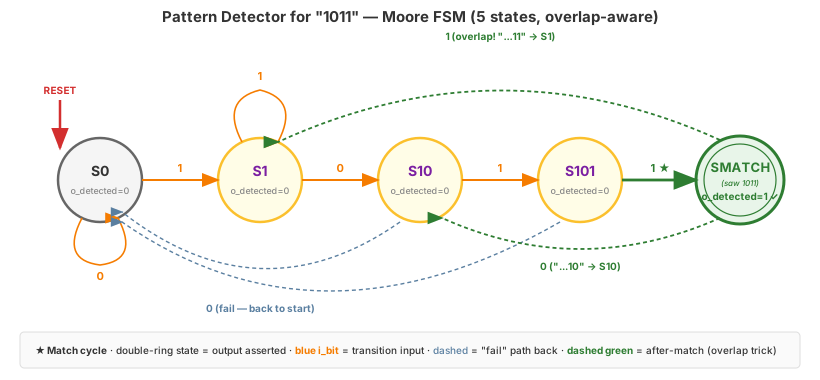
SMATCH on a 1, we don't go back to S0 — we go to S1. Why? Because the 1 we just consumed could be the start of the next match. From SMATCH on a 0, the last two bits are 10, which is a prefix of 1011 — go to S10. Always keep the longest suffix that's still a valid prefix.
🧪 You Do — Walk the FSM
Input stream 1 0 1 1 1 0 1 1. Trace the state and o_detected per cycle.
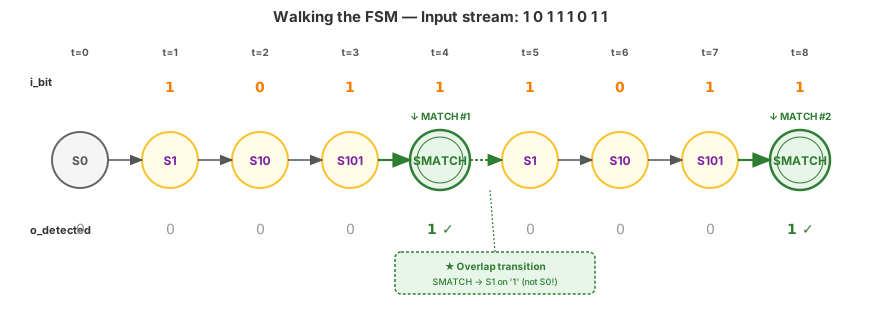
t=4→t=5 is the SMATCH → S1 transition that makes back-to-back matches possible. Forgetting this edge is the classic bug — your second match would never fire.
Pattern Detector: From Diagram to Working FSM
~6 minutes
▸ COMMANDS
cd lecture_examples/week2_day07/d07_s4_ex2/
cat day07_ex02_pattern_detector.v   # 3-block "1011" Moore
make sim     # covers overlap + near-miss
make wave
make stat
▸ EXPECTED STDOUT
PASS: reset -> S0 (no detect)
PASS: detects '1011'
PASS: ignores '1010' (no match)
PASS: overlap: detects first '1011'
PASS: overlap: detects second '1011'
=== 18 passed, 0 failed ===

  SB_DFF:  3   (5 states -> ceil(log2 5)=3)
  SB_LUT4: ~6
▸ GTKWAVE
Signals: i_bit · r_state · o_detected. Watch state traverse S0→S1→S10→S101. Detection pulses are 1-cycle wide. The overlapping pattern exercises the S101→S1 transition explicitly.
FSM Coding Checklist
- ☐ State diagram drawn on paper before opening the editor
- ☐ Hand-walk at least 2 test cases, including edge cases
- ☐ 3 separate
alwaysblocks (state reg, next-state, output)- ☐ Block 1 is trivial (just DFF with reset)
- ☐ Block 2: default assignment first (
r_next = r_state;),default:case at end - ☐ Block 3: default output assignments for every output,
default:case at end
- ☐ States use
localparam, never magic numbers - ☐ Nonblocking
<=in sequential (Block 1); blocking=in combinational (Blocks 2, 3) - ☐ Self-checking testbench covers every transition, including error paths
🤖 Check the Machine
Ask AI: “Design an FSM that detects the pattern ‘110101’ in a serial bit stream. Include the state diagram description, 3-block Verilog, and a self-checking testbench with overlapping test cases.”
TASK
Ask AI for a complete FSM package.
BEFORE
Predict: 6 states + idle, 3-block Verilog, overlapping sequence tests.
AFTER
Strong AI handles overlaps. Weak AI only handles non-overlapping cases — subtle bug.
TAKEAWAY
Always test the overlap case. AI-written FSMs commonly miss it.
Key Takeaways
① Draw the state diagram before writing code.
② Walk test cases with a pencil. Catch bugs in diagrams, not in Verilog.
③ Pattern detector overlaps: new match can begin from a partial match.
④ Test every transition, including the edge cases.
Pre-Class Self-Check
Q1: Why is the state diagram drawn before the Verilog?
Q2: What transition happens when a pattern detector is in its near-final state and receives an input that completes an overlapping prefix?
Pre-Class Self-Check (cont.)
Q3: For a 6-state FSM on iCE40, which encoding is likely more compact?
make stat.Q4: Name three cases your testbench must cover for a pattern detector.
🔗 End of Topic 7
Next Topic: Modules Within Modules
Topic 8 · Hierarchy, Parameters, Generate
▸ WHY THIS MATTERS NEXT
You've built modules up to a few hundred lines. Real designs have thousands of lines, across dozens of files, arranged hierarchically. Topic 8 teaches the three Verilog features that make this scale: module hierarchy, parameters for configurable IP, and generate blocks for array-style replication. By end of Topic 8 your growing module library will become a reusable toolbox.