🌍 Where This Lives
Where it shows up
Linux is 30 million lines of code. The chip in your phone is hundreds of millions of gates. The CERN ATLAS detector handles a petabyte of raw data per second. None of these has ever been held in any one person's head, and every one of them works. The trick is the same one architects use for skyscrapers: nobody draws the whole building — they draw the rooms, and the rooms are made of walls, and the walls are made of bricks.
When it goes wrong
Boeing's 737 MAX MCAS was added without any one engineer tracing how it interacted with the rest of the autopilot. Ariane 5 reused a piece of Ariane 4 code that no longer made sense in its new context — but it was copied, not instantiated, so the assumption it carried was buried and forgotten. When the structure isn't clean, the failure modes get clever in ways no individual reviewer can anticipate.
⚠️ Named Ports Are Mandatory
❌ Wrong Model
counter c1 (clk, rst, en, count); — positional connection. Shorter, right?
✓ Right Model
counter u_cnt0 (.i_clk(clk), .i_reset(rst), .i_enable(en), .o_count(count)); — named port connection. If someone adds a port, swaps an order, or adds an input, positional connections silently break. Named connections fail at compile — fast, loud, fixable.
.port(signal).
👁️ I Do — Instantiate a Debouncer
// Top-level — wraps debounce as sub-module
module button_handler (
    input  wire i_clk, i_reset, i_btn_raw,
    output wire o_btn_clean
);
    // Instantiate by name
    debounce #(.CLKS_STABLE(500_000)) u_debounce_sw1 (
        .i_clk   (i_clk),
        .i_reset (i_reset),
        .i_noisy (i_btn_raw),
        .o_clean (o_btn_clean)
    );
endmodule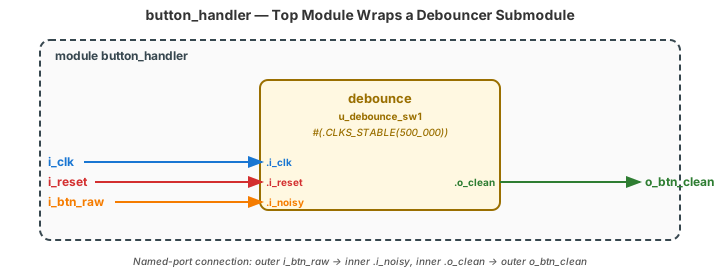
u_debounce_sw1, not u1. (2) Parameter override #(.CLKS_STABLE(500_000)). (3) Named ports — .i_clk(i_clk). Each colored signal in the code maps to the same-colored arrow in the RTL.
🤝 We Do — Naming Conventions
| Concept | Prefix / Pattern | Example |
|---|---|---|
| Module input | i_ | i_clk, i_data |
| Module output | o_ | o_sum, o_valid |
| Module inout (rare) | io_ | io_bus |
| Internal register | r_ | r_state, r_counter |
| Internal wire | w_ | w_sum, w_carry |
| Module instance | u_ | u_debounce_sw1 |
| Compile-time constant | ALL_CAPS | CLKS_STABLE, WIDTH |
u_uart_rx.r_state, you instantly know: this is a register inside the uart_rx instance. The conventions aren't arbitrary — they're the lowest-cost way to make signals navigable.
🧪 You Do — Spot the Bad Hierarchy
module top (input wire clk,
            input wire data_in,
            output wire done);
    wire x, y, z;
    submod1 u1 (clk, data_in, x);
    submod2 u2 (x, y);
    submod3 u3 (clk, y, z);
    submod4 u4 (z, done);
endmodule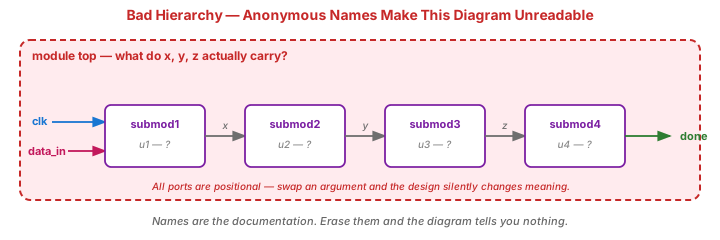
List the code-review issues.
- Positional port connections everywhere — swap one and you'd never know.
- Meaningless instance names (
u1,u2, ...) — unreadable in waveforms. - Meaningless wire names (
x,y,z) — can't tell what they carry. - Module names say nothing (
submod1) — file-naming bug.
.ports, meaningful instances (u_decoder, u_filter), wires named for their purpose (w_decoded_byte).
Build a Hierarchical Design
~5 minutes — sync + debounce + edge = button_handler
▸ COMMANDS
cd lecture_examples/week2_day08/d08_s1_ex1/
ls *.v               # 4 module files + tb
cat day08_ex01_button_handler.v   # top-level composition
make sim
make stat            # total for full hierarchy
make prog
▸ EXPECTED STDOUT
sync_2ff.v
debounce.v
edge_detect.v
day08_ex01_button_handler.v
tb_button_handler.v

PASS: sync works
PASS: bounces filtered
PASS: 1-cycle release pulse
PASS: 1-cycle press pulse
=== 8 passed, 0 failed ===

Per-instance breakdown:
  u_sync:     2 SB_DFF
  u_debounce: ~30 cells
u_edge: 1 SB_DFF + 1 LUT🔧 Hierarchy Preserved or Flattened?
$ yosys -p "read_verilog *.v; hierarchy -top button_handler; synth_ice40; stat"

=== button_handler ===     ← top level
   Number of cells:       42
     $scopeinfo             3    ← hierarchy markers (retained)

=== debounce ===           ← sub-module, preserved
   Number of cells:       37
     SB_CARRY              18
     SB_DFFESR             20
...flatten to the Yosys script — useful for critical-path analysis, costly to debug.
🤖 Check the Machine
Ask AI: “I have sync_2ff.v, debounce.v, and edge_detect.v. Write a top-level button_handler module that instantiates all three in the correct order, using named port connections and descriptive instance names.”
TASK
AI composes 3 modules into a top.
BEFORE
Predict: wire chains from sync output → debounce input → edge input.
AFTER
Strong AI uses named ports + u_ instances. Weak AI uses positional.
TAKEAWAY
AI handles composition well if you give it the sub-module port lists.
Key Takeaways
① Hierarchy manages complexity. Real designs are 10+ levels deep.
② Always use named port connections (.port(signal)), never positional.
③ Naming conventions: i_/o_/r_/w_/u_. Descriptive instance names.
④ Yosys preserves hierarchy by default. Flatten only for optimization.
🔗 Transfer
Parameters & Parameterization
Video 2 of 4 · ~9 minutes
▸ WHY THIS MATTERS NEXT
You now instantiate modules. Next: how to make the same module serve different roles through parameters. One counter module that's 8-bit in one place, 16-bit in another, with any CLKS_STABLE value. This is IP reuse — and it's how industry scales.