🌍 Where This Lives
In Industry
16× oversampling is the standard across every UART implementation since the original 8250 UART chip (1970s). Intel's 8250, 16550A, and descendants all use 16×. FTDI USB-UART chips use 16×. ARM's PL011 UART uses 16×. Your FPGA vendor IP uses 16×. Once you learn this technique, you can reverse-engineer any UART RX in under 10 minutes. Also: 16× is the foundation of every clock-recovery scheme in modems, SerDes, and high-speed links.
In This Course
Topic 11 TX was straightforward — you controlled the timing. Today's RX is the hard part, and the “16× oversampling” trick is what makes it work. Once you have RX working (Video 2), you have full-duplex UART on your Go Board. Topic 12 Video 3 introduces SPI; Video 4 integrates everything.
⚠️ Receive Timing Is Not Your Timing
❌ Wrong Model
“For RX, I'll just reverse the TX: count CLKS_PER_BIT cycles, sample the line, move to the next bit.”
✓ Right Model
You don't know when the byte arrives. The transmitter's clock and yours drift independently up to ±2%. If you sample at CLKS_PER_BIT intervals starting from the detected start edge, by bit 8 your sample point has drifted well into the next bit. You need to sample in the middle of each bit, not at the edges, to tolerate drift. 16× oversampling gives you the machinery to do this.
👁️ I Do — The 16× Oversampling Scheme
   One bit time (CLKS_PER_BIT cycles)
   ├─────────────────────────────────────┤
    │ │ │ │ │ │ │ │ │ │ │ │ │ │ │ │ │
    0 1 2 3 4 5 6 7 8 9 A B C D E F        ← 16 oversample slots

              ▲         ▲
              │         │
            start      mid-bit sample point
            edge       (slot 8)   → this is the value
CLKS_PER_OSX = CLKS_PER_BIT / 16. At 25 MHz/115200 baud: 217/16 = 13.6 cycles per oversample slot. The FPGA counter counts up to 13 or 14 cycles per oversample.
🤝 We Do — Start-Bit Detection
// 1. Synchronize the async RX line
//    (2-FF sync — Topic 5 returns!)
reg r_rx_sync1, r_rx_sync2, r_rx_sync3;
always @(posedge i_clk) begin
    r_rx_sync1 <= i_rx;        // metastab
    r_rx_sync2 <= r_rx_sync1; // stable
    r_rx_sync3 <= r_rx_sync2; // 1 cycle earlier
end
wire falling_edge =
     r_rx_sync3 & ~r_rx_sync2;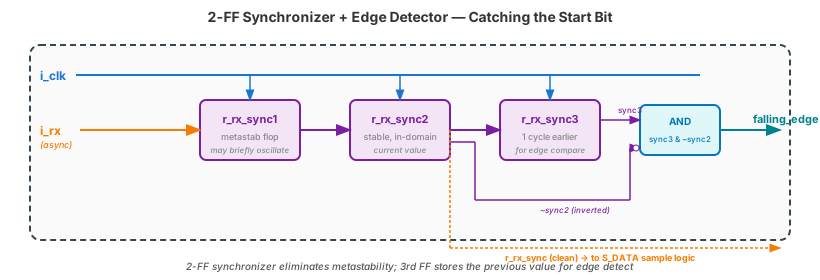
🧪 You Do — Why 16 And Not 4 Or 64?
Why does UART RX use 16× oversampling? Why not 4× (cheaper) or 64× (more precise)?
- 4×: Middle of bit = slot 2. Only 1 sample on each side of true middle → poor tolerance to clock drift. Fails at ±1% mismatch.
- 8×: Better, but still sensitive to start-bit detection jitter.
- 16×: Middle at slot 8. ±7 slots (~43% of bit time) of drift tolerance. Standard since 1970s.
- 64×: Excellent tolerance but 4× the counter width, 4× the clock speed requirement. Diminishing returns for UART.
Oversampling Decision Visualization
~4 minutes
▸ COMMANDS
cd lecture_examples/week3_day12/d12_s2_ex1/
python3 plot_sampling.py
# walks +0%..+10% drift,
# 4× / 8× / 16× / 64× side-by-side
▸ EXPECTED OUTPUT
Drift   4×   8×  16×  64×
+2.0%    9    9    9    9
+3.0%    8    9    9    9
+5.0%    5    7    8    9
+7.0%    3    5    6    6

(value = last bit sampled
correctly in a 10-bit frame)🤖 Check the Machine
Ask AI: “Design a UART RX module with 16× oversampling. Describe the counter hierarchy, start-bit validation logic, and sample-point calculation.”
TASK
AI describes 16× oversampling RX.
BEFORE
Predict: 2 counters (oversample + bit), 2-FF sync, start-bit revalidation at slot 8.
AFTER
Strong AI mentions glitch rejection via mid-start resample. Weak AI skips this.
TAKEAWAY
The mid-bit resample is what distinguishes robust RX designs from fragile ones.
Key Takeaways
① RX is harder than TX — you don't control the timing.
② 16× oversampling is the universal UART RX trick.
③ Sample each bit at its midpoint (slot 8 of 16).
④ 2-FF sync + edge detect + mid-bit revalidation = robust design.
🔗 Transfer
RX Implementation
Video 2 of 4 · ~12 minutes
▸ WHY THIS MATTERS NEXT
You have the theory. Video 2 is the build: FSM states, oversample counter, sample-and-shift logic. Full working Verilog. End of Video 2: your Go Board echoes characters you type in your terminal. Full-duplex. Your RTL has become a conversation partner.