🌍 Where This Lives
In Industry
Open-source: every SV project on GitHub uses logic. PicoRV32, Ibex, CORE-V, BlackParrot, RocketChip — not a reg declaration in sight. Commercial: Intel's, AMD's, and Apple's design style guides mandate logic for all new code. The wire/reg distinction is strictly maintenance-mode in modern flows.
In This Course
From Topic 13 on, all new code uses logic. Your Week 1-3 library is optionally modernized (simple find/replace: wire → logic, reg → logic, except in module ports where the distinction is irrelevant). Your Topic 14 assertions assume SV style.
⚠️ “reg Means Register”
❌ Wrong Model
“reg declarations become flip-flops. wire declarations become combinational logic. The type tells me the hardware.”
✓ Right Model
The reg keyword has nothing to do with registers. It's a procedural assignment target — a variable you can assign inside always, initial, or task blocks. Whether it becomes a flip-flop, a latch, or combinational logic depends entirely on the always block that drives it. reg is a confusing name for “assignable variable.”
reg inside always @(*) → combinational. reg inside always @(posedge clk) → flip-flop. The keyword does not decide. The block decides. logic drops the misleading name and acknowledges: “any 4-state signal, the synthesis tool figures out the hardware.”
👁️ I Do — Verilog-2001 vs SystemVerilog
VERILOG-2001
module counter (
    input  wire       clk, rst,
    output reg  [7:0] count    // reg in port
);
    // internal:
    wire [7:0] next_count;
    reg        load_done;

    always @(posedge clk)
        if (rst) count <= 0;
        else     count <= next_count;

    assign next_count = count + 1'b1;
endmodule
SYSTEMVERILOG
module counter (
    input  logic       clk, rst,
    output logic [7:0] count
);
    logic [7:0] next_count;
    logic       load_done;

    always_ff @(posedge clk)
        if (rst) count <= 0;
        else     count <= next_count;

    assign next_count = count + 1'b1;
endmodule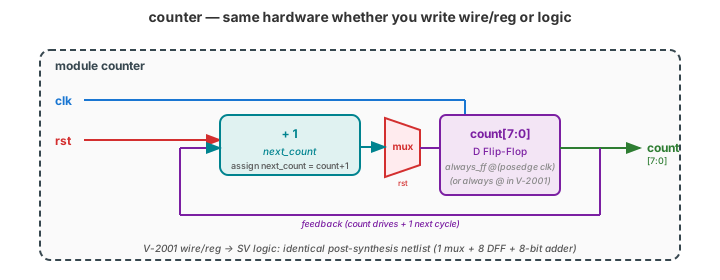
logic, regardless of whether it's driven by an always block or a continuous assignment.
🤝 We Do — The Conversion Rules
| Verilog-2001 | SystemVerilog | When |
|---|---|---|
wire | logic | Always, except for specific bidirectional/tri-state uses |
reg | logic | Always |
wire [7:0] | logic [7:0] | Always |
wire signed | logic signed | Always |
wire [31:0] arr [0:15] | logic [31:0] arr [0:15] | Always — same semantics |
logic supports only single-driver semantics. If a signal has multiple drivers (tri-state bus, bidirectional I/O, or parallel combinational drivers), use wire or the 4-state bus types (tri, wand, wor). For 99% of RTL you'll write, single-driver is what you want — and logic actually catches accidental multiple drivers as a warning.
🧪 You Do — Modernize This Snippet
module uart_tx_ctrl (
    input  wire        clk, rst, start,
    input  wire  [7:0] data,
    output reg         tx_busy,
    output wire        tx_line
);
    reg  [3:0] state;
    reg  [9:0] shifter;
    wire       bit_tick;
    reg  [7:0] count;
    // ...
endmodule![RTL diagram of uart_tx_ctrl: clk (blue), rst (red), start (magenta) and data[7:0] (orange) feed an FSM + datapath block with internal regs state (purple), shifter (amber), count (purple), and bit_tick wire (teal); outputs tx_busy (magenta) and tx_line (green). All wire/reg become logic in SV.](diagrams/d13_s2_uart_tx_ctrl_rtl.svg)
Rewrite the declarations in SV style.
module uart_tx_ctrl (
    input  logic       clk, rst, start,
    input  logic [7:0] data,
    output logic       tx_busy, tx_line
);
    logic [3:0] state;
    logic [9:0] shifter;
    logic       bit_tick;
    logic [7:0] count;
    // ...
endmodulelogic. No decision fatigue. The synthesis tool infers flops, combinational logic, or wires based on how each signal is driven — not on how it's declared.
Modernize Your Debouncer
~4 minutes — Week 2 module, SV-ified
▸ COMMANDS
cd lecture_examples/week4_day13/d13_s2_ex1/
# day13_ex01_debounce_sv.sv is the SV-modernised
# version of shared/lib/debounce.v -- wire/reg
# replaced by logic, always -> always_ff.
make sim     # iverilog -g2012 + vvp
make stat    # yosys synth_ice40 -- same cells
▸ EXPECTED STDOUT
PASS: stable 0 passes through
PASS: stable 1 passes through
PASS: 1-cycle glitch filtered
PASS: bouncing settles after window
=== 4 passed, 0 failed ===

# same hardware, same cell count
▸ KEY OBSERVATION
A find/replace (wire/reg -> logic, always -> always_ff) modernizes the whole file. Your Week 1-3 library can be SV-ified in minutes. The testbench still passes because behavior is identical.
🔧 The 4-State Value System (Unchanged)
logic keeps Verilog's 4-state value system: 0, 1, X, Z. You can still track uninitialized state (X) and high-impedance (Z) — nothing semantic changes.
| Value | Meaning | Common in |
|---|---|---|
0 | Logic low | Everything |
1 | Logic high | Everything |
X | Unknown / uninitialized | Simulation of uninitialized FFs, X-propagation bugs |
Z | High-impedance (floating) | Tri-state buses, inout ports |
bit, byte, int, shortint, longint. These are SV additions that skip the 4-state overhead in simulation (faster sim). For RTL, stick with logic.
🤖 Check the Machine
Ask AI: “I converted my Verilog to SystemVerilog by replacing wire and reg with logic. My testbench now fails with 'X' values on signals that used to work. What's wrong?”
TASK
AI diagnoses a post-migration X-value bug.
BEFORE
Predict: multiple drivers on a logic signal (allowed for wire, warned for logic).
AFTER
Strong AI mentions single-driver rule. Weak AI flails.
TAKEAWAY
The X-on-logic symptom is a classic multi-driver catch. AI that knows the single-driver rule diagnoses fast.
Key Takeaways
① logic replaces both wire and reg. Use it for all RTL signals.
② reg never meant “register.” The name was always misleading.
③ logic is single-driver — this catches multi-driver bugs at elaboration.
④ Keeps Verilog's 4-state (0, 1, X, Z) semantics. 2-state types (bit, int) are for TB only.
logic.🔗 Transfer
Intent-Based always_*
Video 3 of 4 · ~10 minutes
▸ WHY THIS MATTERS NEXT
You've used always @(*) and always @(posedge clk) all semester. Video 3 replaces them with always_comb, always_ff, and always_latch: variants that forbid the wrong thing at compile time. Same hardware, fewer bugs, better error messages.